The Canadian junior searching for Papua New Guinea’s next big discovery
The oversubscription of a recent capital raising by exploration firm Great Pacific Gold shows investors are bullish on Papua New Guinea’s mining sector. Its Chief Executive Greg McCunn shares the next steps with Business Advantage PNG.
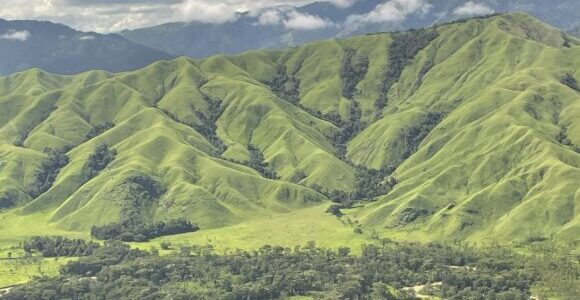
Eastern Highlands Province, near Great Pacific Gold’s Kesar project. Credit: Great Pacific Gold
Investors are confident of more riches being found in Papua New Guinea, if a recent capital raising by Canadian mineral exploration company Great Pacific Gold (GPAC) is any indication.
GPAC initially set out to raise C$10 million (K29.8 million) from a June 2025 private placement, but it ended up securing C$16.9 million – the maximum allowed for the transaction under Canadian regulations.
The proceeds will fund exploration activities at its Wild Dog project in East New Britain Province and the Kesar project in Eastern Highlands Province, both assets that CEO Greg McCunn believes could be similar in size and grade to K92 Mining’s successful Kainantu gold mine.
“Every major institutional shareholder investing in K92 in the early days has done tremendously well on their investment,” McCunn tells Business Advantage PNG.
“That value creation hasn’t gone unnoticed, and investors are looking for what’s next in PNG.”
McCunn’s career has taken him to Australia, Canada, Mexico and West Africa, but he believes that PNG’s high-grade gold deposits are among the best in the world.
Company-making asset

Great Pacific Gold’s Greg McCunn
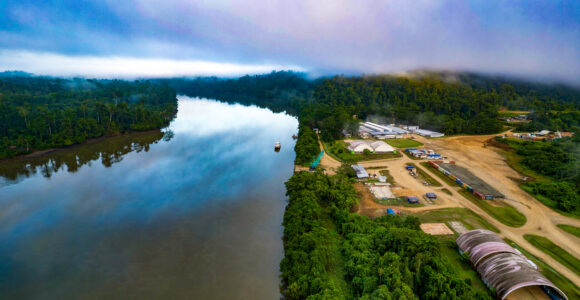
What’s “next” could include Wild Dog, a 1,400 square kilometre land package on the island of New Britain incorporating a former mine that produced around 40,000 ounces of gold under previous owners between 2008 and 2013.
Current exploration is focused largely on an epithermal vein structure that saw some historical drilling, but that “hadn’t had much modern exploration work,” according to McCunn.
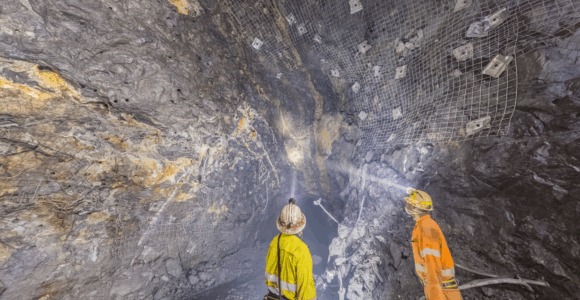
One of the first steps GPAC took after acquiring the asset in 2023 was to bring in Mobile MT, an airborne geophysical survey technology that delivers geoelectrical information from near-surface down to around 1 km underground. This revealed an epithermal structure 15 km in length and continuing down to at least 1,000 metres in depth, demonstrating the potential for Wild Dog to become a “company maker.”
This was followed by a diamond drill campaign commencing in May 2025, which was ongoing as this publication went to print. The high-grade nature of the system has already been evidenced by multiple intercepts, including an intercept of 8.4 metres at 49.9 grams per tonne gold-equivalent from 154 metres down the hole.
Mainland prospects
Meanwhile, in PNG’s Highlands region, GPAC is advancing Kesar, which sits adjacent to Kainantu.
McCunn says Kesar offers “very similar geology” to its neighbour, adding that a diamond drill program completed in April 2025 confirmed gold mineralisation across multiple holes, but didn’t quite reveal the full picture.
“We didn’t feel we were hitting the main Kora- or Judd-style system,” McCunn says, referring to the two veins being mined at Kainantu.
To improve confidence, GPAC again turned to MobileMT for a geophysical survey. This revealed an epithermal system just north of where the drilling had taken place and with a similar “scale and intensity” to Kora and Judd.
GPAC is now using that data to delineate up to 10 targets for a second drilling program commencing in 2026.
People first
McCunn’s career has taken him to Australia, Canada, Mexico and West Africa, but he believes that PNG’s high-grade gold deposits are among the best in the world.
He says another big advantage of operating in PNG is that the world’s biggest gold miners – Barrick Gold and Newmont Corporation – have operated there for a long time.
“What that means is you’ve got really high-quality people. You’ve got good, well-trained geologists who know how to work safely and who know the systems and processes,” he says.
One thing GPAC has learned from others is the importance of community relations, although McCunn says this raises the challenge of managing landowner expectations.
“People forget that we’re not quite there yet. We haven’t found a resource, we’re not about to build a mine tomorrow, but maybe someday we will. So, they have to bear with us and support us while we get there,” he says.
This article was first published in Mining and Energy 2025/26, released in October. Read the full edition here