2026: what can Papua New Guinea business expect from the year ahead?
Final investment decisions on gas projects, a weaker kina and Starlink? Business Advantage PNG looks to the year ahead and considers what PNG-focused businesses can expect in the coming 12 months.

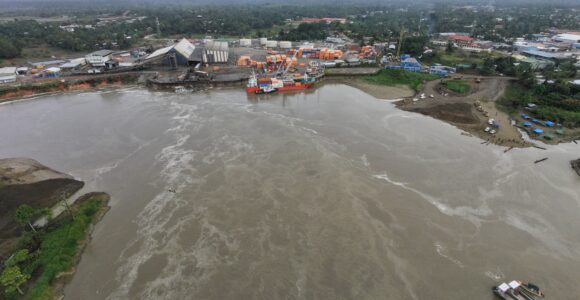
Freight volumes continue to grow at PNG’s busiest port in Lae. Credit: BAI
Papua New Guinea’s economy is expected to grow by 4.0 per cent in 2026, while growth in the non-resources economy is expected to be 4.5 per cent, according to the National Budget delivered last December. This is slightly lower than in 2025, when PNG’s GDP grew by 4.5 per cent.
The International Monetary Fund’s own expectations, also released last month, align with those of the budget, while the Asian Development Bank’s latest projection is for 3.6 per cent GDP growth in 2026.
Inflation is predicted to run at 4.5 per cent during 2026.
There is a word of caution from the IMF, however: “The outlook is subject to high uncertainty, with risks tilted to the downside, as Papua New Guinea remains vulnerable to both domestic and external shocks.”
The year of hydrocarbons?
It is worth noting that the growth predictions above do not take into account the anticipated increase in economic activity that would follow final investment decisions (FIDs) for the TotalEnergies-led Papua LNG project and Twinza’s smaller Pasca A offshore gas project. FIDs for both projects are expected this year.
In the case of Papua LNG, businesses will be watching for the successful completion of the government-organised development forum for the project, expected in the first quarter of the year. This is an essential milestone towards an FID.
In the meantime, both projects are finalising their costs and working to shore up project financing. Last month, Total Energies EP PNG’s Managing Director Arnaud Berthet told an industry forum that seven export credit agencies and over 30 commercial banks had shown “strong interest” in financing his project. The successful final repayment of the debt facility for the previous Exxon-Mobil-led PNG LNG project late last year should help support these negotiations.
Reforms to PNG’s oil and gas regime are still in the pipeline. Petroleum Minister Jimmy Maladina has flagged the intent to move to a production-sharing regime before the end of PNG’s 50th birthday year in September, with the recently-constituted National Petroleum Authority to play a central role.
Currency
While PNG’s foreign exchange shortages have improved markedly in the past 12 months, providing much-needed relief for businesses, the purchasing power of PNG’s currency is likely to come under greater scrutiny this year.
During 2025, the PNG kina fell by 5.1 per cent in value against the US dollar, 12.28 per cent against the Australian dollar and 16.54 per cent against the euro. With the Bank of PNG pursuing a “crawling peg” devaluation, the prevailing view is that the kina may still have further to fall, although an influx of investment dollars for major projects could move the kina in the other direction.
It will be interesting to see how the central bank’s new board, led by Sir Robert Igara following the retirement of David Toua last month, approaches these challenges.
Connectivity
Will this finally be the year of Starlink? Before Christmas, the estimated 1800 PNG-based subscribers to the satellite-based internet service received a shock when they were cut off by the service, under instructions from PNG’s regulator, NICTA.
“Starlink is currently not licensed to operate in Papua New Guinea. Despite this, NICTA has observed ongoing importation, supply, installation, and use of Starlink terminals across the country over recent months,” said a statement authorised by NICTA’s Chairman, Brian Riches.
NICTA is ready to licence Starlink but is constrained by a legal case caused by a March 2024 ruling by PNG’s Ombudsman Commission. This was finally heard by the National Court in September 2025 but a decision is still pending.
While PNG waits to join other Starlink-using countries in the Pacific like Fiji, Tonga and Vanuatu, there is other more positive news on connectivity. Last month, it was announced that Google will play a role in constructing three domestic undersea cable networks. The work will be funded by Australia under its Pukpuk mutual defence treaty commitments and ties into PNG Dataco’s existing plans to expand PNG’s National Transmission Network.
The long-term impact of the Pukpuk Treaty, signed in September 2025, is likely to be far-reaching, involving not only direct defence-related spending on training and construction, but also investment in supporting infrastructure.
Infrastructure

A new Airbus A220-300 arriving in Port Moresby last month. Credit: Air Niugini.
“Power is our most pressing issue – it affects the whole community, “John Byrne, President of the Lae Chamber of Commerce and Industry, tells Business Advantage PNG.
“PNG Power Ltd’s (PPL) new management are open, transparent and need to be provided government support, funding and payment of government power bills to enact the seven-stage plan, as outlined by CEO Paul Bayly.”
Encouragingly, last month the Asian Development Bank confirmed US$110 million in finance for the first of a two-part program “to restore the sustainability of the power sector, revitalise PPL’s operational performance, and increase private sector participation.”
Byrne says Lae’s business community is also looking for upgrade work to commence on several key roads, mostly notably the Lae–Bulolo–Wau Road.
In aviation, the upgrade of Air Niugini’s fleet is continuing, with the delivery of its second and third Airbus A220-300s last month. The national carrier now offers A220-300 services on routes from Port Moresby to Lae, Manus Island, Kavieng, Alotau and Rabaul. International routes will follow soon, it says.
Meanwhile, Qantas last month confirmed that it will compete with the national airline on the Sydney–Port Moresby route from March this year.
Mining
Hopes remain that negotiations between the government’s State Negotiation Team and the developers of the tier one Wafi-Golpu copper-gold project can reach a resolution this year.
According to Chief Operating Officer Jaco Boshoff, Harmony Gold’s board is also this year expected to make a decision on extending the life of its Hidden Valley mine out to 2040, following its lodgement of an application to extend its mining lease last year.
We can also expect more progress on Pacific Lime and Cement’s lime and cement project, following the signing last month of a Project Development Agreement with the government and PLC’s subsequent listing on PNGX.
Building and construction
Port Moresby can be expected to see more property development this year, including at Steamships’ Portside Business Park, stage three of MRDC’s Star Mountain Plaza, the Paga Hill tourism zone, the Chinatown development and the Constantinou Group’s 151-hectare Jacksons Heights project. Notably, Jacksons Heights is one of the first major developments to take advantage of PNG’s 2022 Strata Title Act.
PNG’s property developers will also be hoping to hear soon who will be developing the facilities and accommodation for the PNG Chiefs team, which will enter Australia’s NRL competition in 2028.
Commodity prices
Prior to the United States’ extraordinary intervention this month in Venezuela, most analysts were predicting oil prices to soften further this year, after falls of around 20 per cent last year. The crude oil price is currently sitting at around the US$58 per barrel.
PNG’s Treasury expects LNG prices to average US$11.7 per million British thermal units (mmBtu) in 2026, slightly down from US$12.3 mmBtu in 2025.
In metals, average prices for both copper and gold prices are expected to stay strong this year, with Treasury projecting copper averaging US$9940 a tonne (compared to US$9648 per tonne last year), and gold averaging US$3540 per ounce (compared to US$3657 last year).
Higher cocoa and coffee prices have contributed significantly to PNG’s agricultural sector in the past two years. The price of cocoa has fallen significantly from its April 2024 peak but both commodities are still higher than historical averages. This year, the Department of Treasury expects coffee prices to ease to an average of US$8,098 per tonne and cocoa to average US$7,148 per tonne. Palm oil prices are expected to remain steady.
Sundry items
Two important reforms related to business have come into effect this month: the new Income Tax Act and a new national minimum wage of K5.00 per hour (rising to K5.25 in January 2027 and K5.50 in January 2028).
In response to concerns about the implementation of the new tax regime for employer-supplied motor vehicles, the Internal Revenue Commission has reassured businesses that the first quarter of the year will be a “designated transitional period” and that “employers who act in good faith and make genuine efforts to comply with the new law will not be unfairly penalised”.
Finally, we will see at least one more international brand enter PNG’s hotel market in the first half of this year, with the rebranding of the Stanley Hotel as a Sheraton.