From first contact to AI: Papua New Guinea’s steep innovation learning curve
Papua New Guinea has seen rapid technological change in a short time, with some communities going from no contact with the outside world to having access to digital tools in the space of a generation. Nadav Shemer Shlezinger speaks with tech sector leaders about the progress being made, and what’s next for PNG to fulfill its innovation potential.

Investments in terrestrial infrastructure, including thousands of kilometres of fibre cables and data centres in Port Moresby and Madang, have been important in driving down wholesale bandwidth prices. Credit: iStock
Digital infrastructure is “a crucial prerequisite” for the creation and adoption of digital technologies, according to the World Bank’s 2023 Digital Progress and Trends Report.
This principle is clearly understood in Papua New Guinea, where state-owned PNG DataCo has invested heavily in expanding the National Transmission Network.
“This is a new type of investment for this market, and hopefully it can provide opportunities for other startups in this region.”
The Coral Sea Cable System, a 4,700 km fibre-optic cable built in 2019 that connects PNG to Australia and the Solomon Islands, and which was partially funded by PNG DataCo, was “our most significant investment in terms of international connectivity,” according to Chief Executive Paul Komboi.
Investments in terrestrial infrastructure, including thousands of kilometres of fibre cables and data centres in Port Moresby and Madang, have been equally important in driving down wholesale bandwidth prices from K1,250/Mbps in 2018 to K209/Mbps in August 2025, in Komboi’s opinion.

PNG Dataco’s Paul Komboi. Credit: BAI
“That is the main driver. It’s the connectivity that drove down the price and created a much more resilient backbone network for the country,” Komboi says.
Towers built by PNG’s telecommunications providers have brought widespread internet access into rural areas, according to Russell Tato, Acting CEO of Datec, a state-owned provider of ICT solutions.
“That’s opening up the market. We are seeing demand,” Tato says, adding that, “with the ISP [internet service provider] and satellite bandwidth opening up the market, a lot of the corporates are now investing in on-prem[ises] infrastructure.
Vodafone has built 800 towers nationwide since becoming PNG’s third telco in 2022.
According to Regional Chief Executive Officer, Pradeep Lal, every one of these sites is 4G-plus enabled, underscoring the company’s focus on a data-centric network.
“The real difference we’ve made is affordability. By offering plans that people can genuinely access, we now carry 55 per cent of the country’s data usage. The demand has always been there, we can see that the people want to use it if you make it affordable.”
From first contact to AI
In a recent speech, Prime Minister James Marape observed that many communities in PNG have gone from having no contact with the outside world to having access to the digital world within one generation.
“I am a living example,” Marape said, recalling his childhood in Huli country in the Highlands Region in the 1970s, when shells were still used as currency and communication with the outside world meant walking for days. Today, he noted, he can complete all his office work using ICT tools, including tools powered by artificial intelligence.
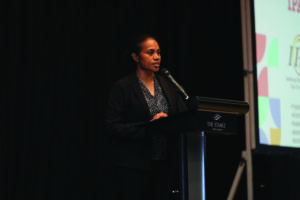
The Digital ICT Cluster’s Priscilla Kevin. Credit: BAI.
So far, the development of high-powered digital applications in PNG has been largely restricted to large corporations or government institutions, although they are increasingly being made available to regular consumers.
For example, PNG’s largest private superannuation fund, Nasfund, recently developed an AI tool to streamline its accounts payable process.
In November, the government introduced a Digital ID, known as SevisPass, which citizens will be able to use to be instantly verified for a range of services online.
Earlier in 2025, the government’s Immigration and Citizenship Services Authority launched an AI solution to streamline assessments of visa applications.
“It was the first use of generative AI for government workload in the Pacific, but not the last,” says James Inglis, Founder of NiuPay, the Port Moresby firm which developed the solution.
In October, Kina Securities agreed to pay US$5 million to acquire a 17 per cent share in NiuPay, in what is believed to be the first equity deal for a tech company in PNG.
“This is a new type of investment for this market, and hopefully it can provide opportunities for other startups in this region,” Inglis says. “We see a lot of guys with great ideas that don’t have access to the same capital markets because of the scale of what we do.”
Training in tech
The next frontier for PNG is investing not just in technological infrastructure, but in its human infrastructure – equipping budding entrepreneurs with the skills and spaces to innovate.
NiuPay is in discussions with a local university to help redesign its curriculum to educate students in the use of cutting-edge technologies.
The PNG Digital ICT Cluster is another organisation dedicated to this mission. Established in 2014, it has supported the development of the innovation ecosystem by promoting various initiatives, including innovation hubs for micro, small and medium enterprises (mSMEs), providing them with access to features such as internet services, Wi-Fi, IT tools, training programs, and business and e-government services.
Recently, it announced a partnership with the National Information and Communications Technology Authority to roll out and support three pilot digital mSME business hubs in PNG.
For Priscilla Kevin, co-founder of the PNG Digital ICT Cluster, these hubs are as much about connecting entrepreneurs with each other as they are about skills and training.
Currently, “the conversations are happening in siloed spaces and are very disconnected and fragmented,” says Kevin.
“When you create hubs, then the conversations get bigger and louder because there’s more activities happening in those spaces.”