Waste not, feed more: poultry farm’s award-winning solution has wings
A small poultry farm in Papua New Guinea’s Central Province has found a sustainable way of reducing its dependence on expensive stock feed. Its solution, which harnesses the power of a humble insect, was one of the big winners in this year’s Innovation PNG Awards.
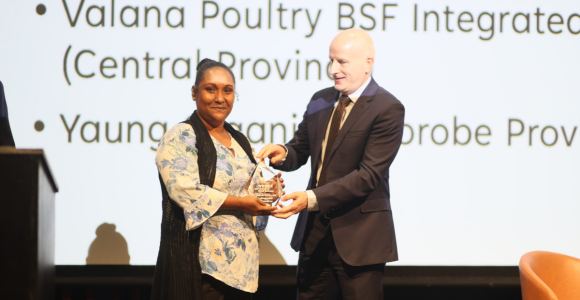
The Innovation PNG Award for Small Business sponsored by Kina Bank was awarded to Valana Poultry BSF Integrated Agro Farm and presented by Ivan Vidovich. Credit: Lennox Matainaho
Poultry is an increasingly important source of protein in Papua New Guinea, with the bulk of local production coming from smallholder farmers. One of the major constraints on the growth of this sector, however, is the high cost of poultry feed, which is often imported.
“Normally, rearing chickens takes around six weeks but, with the BSF, it can take around four weeks”
This year’s Innovation PNG Award for Small Business (sponsored by Kina Bank) has gone to a farm owner in Central Province for implementing a decidedly low-tech solution to exactly this problem: a poultry feed supplement made from the larvae of the Black Soldier Fly (BSF).
The Valana Poultry BSF Integrated Agro Farm turned to this solution in 2025 to help reduce its reliance on expensive stock feed. Stock feed had previously accounted for around 70 per cent of the farm’s costs, according to Valana Poultry owner Jamie Solien Lalana.
The BSF process involves raising the larvae on a diet of chicken manure, kitchen scraps and garden waste. The larvae eventually mature into a high-protein organic feed which is then mixed with stock feed and given to the chickens.
“This makes my poultry farm a circular system where nothing is wasted,” Lalana said in her acceptance speech at the Innovation PNG Awards ceremony in Port Moresby last month.
Lalana is still testing the optimal ratios of larvae and stock feed, but she is already seeing results.
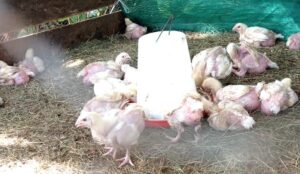
Raising BSF larvae-fed meat birds. Credit: Valana Poultry BSF Integrated Agro Farm
“Normally, rearing chickens takes around six weeks but, with the BSF, it can take around four weeks,” she said.
“With the use of BSF, I can sell birds earlier if customers need them. When I keep the [the birds] longer, the meat stays tender, juicy and tasty.”
Making BSF work in PNG
There were challenges to implementing the solution, with one major concern being the conditions for growing the larvae in PNG’s climate, given BSF isn’t native to PNG.
“BSF larvae can only be produced in suitable conditions, temperature, humidity and with proper lighting,” Lalana explains.
“Very strong winds, high temperatures, very cold nights and unpredictable weather patterns can all [impact] the reproductive cycle of BSF larvae.”
However, she adds, “all this can be overcome with the help of new technologies that have become available.”
Big opportunity
Lalana was introduced to BSF farming when she participated in a training program for women farmers supported by the Australian Centre for International Agricultural Research. Aside from BSF, the program also focused on practical skills in areas such as organic waste processing and climate-smart gardening.
In her speech, Lalana called BSF a “big opportunity” for the agricultural and aquacultural sectors. She expressed her hope of seeing it replicated in farming operations around Papua New Guinea.
“PNG is our roots,” she said. “This is where we belong. We belong to the oceans and the vast land.”