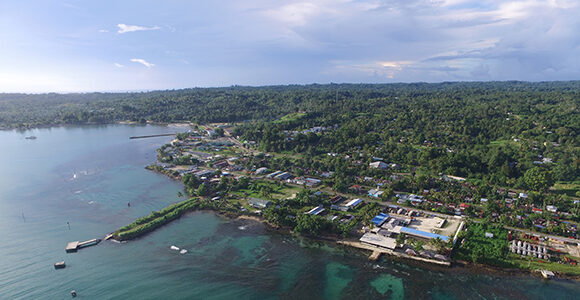
New Ireland is one of the northernmost islands of Papua New Guinea. It is long, narrow and mountainous, with vast stretches of white sandy beaches. The island is part of the Bismarck Archipelago and although 360 km in length, the width is never more than 40 km.
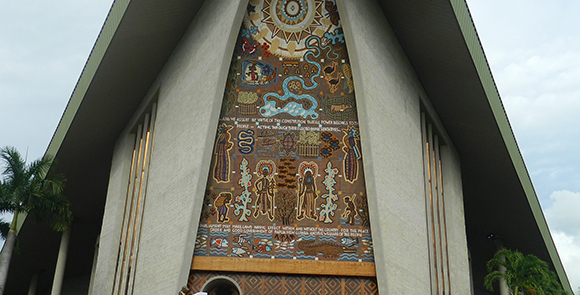
The National Capital District (NCD) is Port Moresby. It is both a city and a district and the gateway to Papua New Guinea – the nation’s capital, centre of politics, trade and commerce. The city, which has become a growing and bustling metropolitan area, is dry, dusty and brown duringthe winter months, but is wet, humid and overgrown in summer. It is located on the southern coast of the country, surrounded by part of Fairfax Harbour.
Morobe is Papua New Guinea’s most populous province and the gateway to the interior of the country.
Also referred to as the Admiralty Islands, Manus Province comprises 18-plus islands covering about 2000 square kilometres of land and 220,000 square kilometres of sea. It is Papua New Guinea’s smallest province. Manus Island is the largest of the islands in the province.
Milne Bay Province takes in the land at the extreme eastern end of Papua New Guinea together with seven groups of islands; the Trobriands, Woodlark, Laughlan, Louisiade Archipelago, the Conflict Group, the Samarai Group and the D’Entrecasteaux Group. The names come from a variety of explorers from as early as 1660.
Madang Province is on the northern coast of Papua New Guinea and has many of the country’s highest peaks and active volcanoes. It also has the widest mix of languages.
The name Jiwaka came about when the first two letters of Jimi, Waghi and Kambia were combined to make a portmanteau word. The province shares its borders with the Western Highlands, Chimbu and Madang provinces. It has three districts—Jimi, North Waghi and Anglimp-South Waghi—and two growing towns, Minj and Banz. Jiwaka was formed by an Act of Parliament in 2009. The centre of Jiwaka is the fertile Waghi Valley, which is surrounded by mountains.
Enga is the highest and is the second most rugged province in Papua New Guinea. Most of the province is over 2000 metres above sea level, but there are also many valleys which feed into the two major river systems that drain the province: the Lagaip, a tributary of the Fly River, and the Lai, a tributary of the Sepik River.
Hela is a smaller province of Papua New Guinea, comprising three districts previously part of Southern Highlands Province. It is home to the Huli Wigmen, who are internationally recognised for their distinctive face paint and elaborate wigs made from human hair.
Chimbu shares its borders with Gulf, Eastern Highlands, Southern Highlands, Jiwaka and Madang provinces. The bustling commercial and administrative centre of Kundiawa perches on a mountainside beside the Chimbu River.