Behind the Supplementary Budget and the ownership changes at Papua LNG
The need to provide more funding to tackle two unwanted impediments was behind Treasurer Ian Ling-Stuckey’s Supplementary Budget this month. Meanwhile, the Papua LNG project has a new operator – with shares in the project changing hands.

The port of Kiunga on the Fly River in Western Province. The Fly is the major waterway servicing one of PNG’s largest productive mines, Ok Tedi. Historically, lower water levels due to El Niño have affected the mine’s productivity. Credit: Western Sandaun Media.
While we await a final investment decision (FID) on Papua LNG, there are higher fuel prices and the El Niño climate event to contend with. These two unwanted impediments were behind Treasurer Ian Ling-Stuckey’s Supplementary Budget this month, which allocated an additional K1.33 billion in expenditure.
The K1.11 billion fuel subsidy introduced in April 2026 will run until at least December, aimed at keeping fuel prices at the pump to March 2026 levels. The temporary removal of GST on some essential household items will also continue to year-end.
The assistance package appears to have helped, albeit at the short-term cost of constraining some other government expenditures.
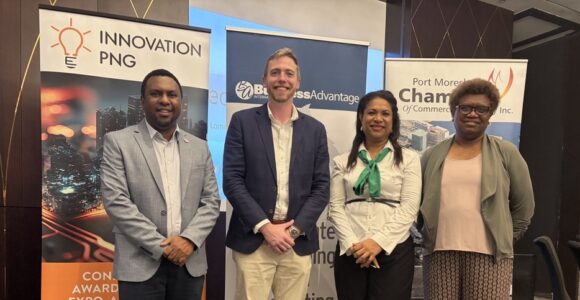
“Because PNG is a net hydrocarbon exporter, its fuel subsidies… have mitigated any negative spillover into the economy as a consequence of this current conflict [in the Middle East],” Dr Brendan Rynne, KPMG Australia’s Senior Economist, observed at the 2026 Business Advantage PNG Investment Conference in August.
El Niño
Also in the supplementary budget is K1.165 billion for the mitigation of a particularly severe El Niño climate event, with lower rainfall already affecting PNG’s farmers, mining projects and hydro power plants.
According to the World Meteorological Organization, the likelihood that El Niño will persist through February 2027 is now close to 100 per cent. The system – which badly affected PNG in 1997/98 and 2015/16, is associated with more extreme weather events.
“Funding to respond to this current El Nino is certainly needed, both to provide relief particularly in the rural areas and to assist villagers to recover their food gardens,” notes Paul Barker, Executive Director of PNG’s industry-funded think-tank, the Institute of National Affairs.
Elections
An additional K150 million in funding for next year’s National General Election is another notable item in the Supplementary Budget.
Papua New Guineans are set to vote in national general elections in mid-July 2027, when PNG’s new five-year electoral cycle will begin. Writs are scheduled to be issued in late April.
There is understandable urgency in government and business circles, therefore, to advance key initiatives before the election period begins.
New Papua LNG project shares
As flagged in our “explainer” on the revised gas agreement for the Papua LNG project earlier this month, ExxonMobil has now officially taken over as operator of the project from TotalEnergies, with the French supermajor reducing its share in the project.
Should FID be reached by the “drop dead deadline” of 15 December and the PNG State take up its participation as expected, the project shares will be:
- ExxonMobil: 34.1 per cent
- Santos: 21.02 per cent
- TotalEnergies: 20 per cent
- Kumul Petroleum: 20.5 per cent (with an option to buy a further 2.5 per cent)
- MRDC: 2 per cent
- ENEOS Xplora: 2.38 per cent
In 2014, ExxonMobil completed the construction phase of the PNG LNG project ahead of schedule and already had the lead role in Papua LNG’s downstream development at Caution Bay, so there will be confidence that the project’s new operator can deliver.