‘Giving teachers their time back’: the young innovator automating classroom paperwork
A young IT graduate has built a mobile app that is saving Kokopo Secondary School teachers hours of manual admin work – and he has ambitions to roll it out in schools across Papua New Guinea. His e-Skul PNG platform was one of the standout winners at this year’s Innovation PNG Awards.

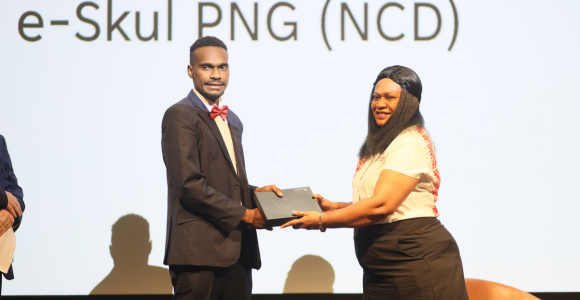
Anthony Tutmulai, winner of the Innovation PNG Award for Young Innovator (sponsored by Moni Plus). Credit: Lennox Matainaho
Teachers in Papua New Guinea’s secondary schools have long had to complete tasks manually – spending hours entering marks, writing report cards and tracking student attendance by hand. For Anthony Tutmulai, a graduate in Information Systems from Divine Word University and the son of a teacher, the problem was personal.
Tutmulai won this year’s Innovation PNG Award for Young Innovator (sponsored by Moni Plus) for creating e-Skul PNG, a mobile app that helps teachers manage student grades and attendance on a local network – with no need for internet access.
“Growing up, during assessment weeks, I would hardly see my mum,” he said at the Innovation PNG Awards ceremony at the Hilton Hotel in Port Moresby. “She would only come home in the afternoon and then go back again to school to enter marks and grade student report cards.”
It was a pattern not unique to his family. Schools across PNG, he noted in his award submission, “still rely heavily on manual processes or basic spreadsheets, which are time-consuming and prone to human error.”
“This is not just a software project – it is a step towards improving the education system.”
Automating the admin
With e-Skul PNG, teachers enter marks once and the system handles the rest – calculating grades, ranking students and generating report cards. “Everything is automated,” Tutmulai said. “This innovation is about giving teachers their time back.”
Teachers can even use the app to scan students’ QR-coded ID cards as they arrive at the school gate – enabling them to record attendance, late arrivals and whether students are wearing the correct uniform.
The system has already been deployed at Kokopo Secondary School, one of East New Britain’s largest schools, with around 1,000 students. “Tasks that previously took hours or days can now be completed much faster and with fewer errors,” Tutmulai said.
Beyond Kokopo
The decision to run e-Skul PNG entirely on a local server within the school was a deliberate design choice, due to challenges with internet connectivity.
Running locally also means the system can be replicated in schools across PNG, including those with poor or no network coverage. Tutmulai sees the Kokopo deployment as a proof of concept and is hoping to expand to other schools, introduce cloud-based options for those with internet access, and build a parent portal so families can track student progress directly.
“My vision is for e-Skul PNG to become a standard platform used across the education system, helping modernise how schools operate in Papua New Guinea,” he said.
“This is not just a software project – it is a step towards improving the education system and supporting the people who hold it together: our teachers.”