How a local fintech solved two ‘serious’ problems with land management
Port Moresby firm NiuPay has found a way to turn Papua New Guinea’s new strata title law into a working, digital reality. Its Digital Strata Title Platform was one of the winners at this year’s Innovation PNG Awards, with founder James Inglis sharing how it works – and the problems it solves – in his acceptance speech.

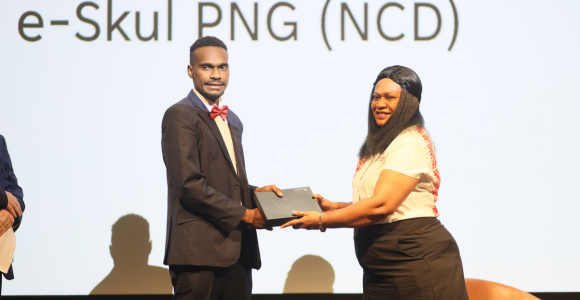
The Innovation PNG Award for Corporate Innovation (sponsored by Vodafone PNG) was awarded to NiuPay Limited. Credit: Lennox Matainaho.
When PNG’s parliament passed the Strata Title Act 2022, it created a legal mechanism to individually own, mortgage and sell a single unit within a development for the first time. But without a system capable of creating, registering and issuing those titles, the reform risked staying theoretical.
NiuPay Limited picked up this year’s Innovation PNG Award for Corporate Innovation (sponsored by Vodafone PNG) for building exactly that system. Its Digital Strata Title Platform, built in partnership with the Department of Lands and Physical Planning (DLPP), issued the country’s first-ever digital strata title – to the Constantinou Group’s Jackson’s Heights development – on 26 March this year.
“We’re now seeing every government agency under the sun looking to see how they can bring their services online.”
Two birds, one platform
“This actually addresses two pretty serious problems with land management,” NiuPay founder James Inglis said at the Innovation PNG Awards ceremony in Port Moresby.
The first was the need to operationalise the Strata Title Act, replacing what he described as a “pretty antiquated” process for multi-tenant ownership, where individuals held shares in a single property such as an apartment building. “The difficulty around rent collection, title security, mortgaging that land – it was pretty challenging,” Inglis said.
Digitising that process should cut what was once a multi-month wait down dramatically. “The result is looking at going from six months [for a title transfer] to, in some cases, same day,” Inglis said, pointing to comparable systems already running in Australia and New Zealand. “Why can’t it be done here?”
The second, longer-standing problem was establishing the provenance of a title at all – proving to a bank or buyer that a property is genuinely what it claims to be. Strata title’s arrival, Inglis said, let NiuPay “kill two birds with one stone”: because strata was a brand-new title type, NiuPay could build provenance and verification into the platform from day one, rather than retrofitting trust onto decades of existing paper records.
A government going digital
Port Moresby-based NiuPay’s relationship with PNG’s public sector dates back to 2020, when the Immigration and Citizenship Services Authority became one of the first agencies to move services online – a shift accelerated by COVID-19 lockdowns. The DLPP partnership followed soon after, with the goal of bringing the department’s entire workflow online.
“I couldn’t think of a more impactful government agency that was also so willing to make that change,” Inglis said of the DLPP.
DLPP’s broader e-Lands program, with NiuPay as technology partner, has already delivered measurable returns: land rent collection has climbed from K10-15 million a year before 2019 to K75 million in 2025, targeting K80 million for 2026.
Inglis, who has spent almost two decades focused on Papua New Guinea’s digital transformation, said demand for this kind of change is now spreading well beyond land and border control.
“We’re now seeing every government agency under the sun looking to see how they can bring their services online and provide more digitally agile business delivery to Papua New Guineans,” he said.
“People shouldn’t have to fly to Port Moresby or get to their nearest provincial centre just to do business with government.”