Papua New Guinean manufacturers ‘have increased their investment in the country’
Most larger Papua New Guinean manufacturers are planning to increase their capital expenditure this year, according to the latest PNG 100 CEO Survey. In this deep dive, sector leaders outline their growth strategies to Business Advantage PNG.
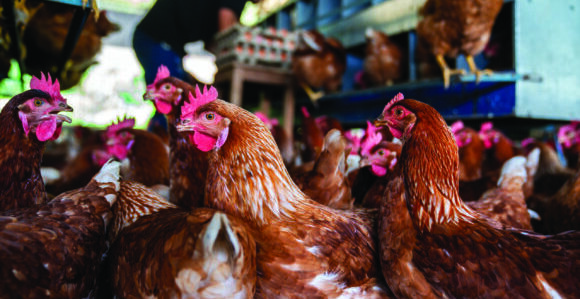
Some PNG companies are hatching plans to expand into poultry, joining major players such as Mainland Holdings in the sector. Credit: iStock
If current investment trends are any indication, then the ‘PNG Made’ logo could soon appear on more products than ever before.
A majority (63 per cent) of larger manufacturers are planning to substantially increase their capital expenditure this year, according to the 2026 Business Advantage PNG / Westpac PNG 100 CEO Survey.
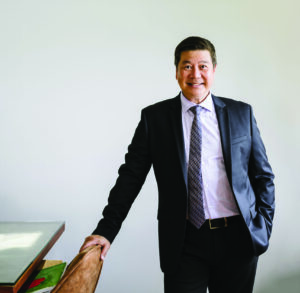
Murray Woo, the Chairman of the Manufacturers Council of PNG. Credit: Morgan Roberts
These results are backed up by Murray Woo, Chairman of the Manufacturers Council of Papua New Guinea, who says that existing manufacturers “have increased their investment in the country”.
Additionally, he says, “a number of companies are looking for import replacements due to supply chain issues, which has increased our membership as companies start investing and manufacturing locally”.
However, he cautions that the Iran war, and rising fuel costs, will increase operating costs for all manufacturers.
Poultry plays
Taylor Pacific is a prime example of the trend towards increased capital expenditure. It joined the ranks of PNG manufacturers in 2024 when it purchased Hugo Canning Co, producer of the Ox & Palm corned beef and Ocean Blue tuna brands. It followed this up in 2025 with the acquisition of 50 per cent of Sepik Fresh Poultry.
Jeremy Fry, the Chief Executive Officer of Taylor Pacific, says his firm has an investment plan aimed at addressing the lack of protein in the average Papua New Guinean’s diet, through providing affordable options.
“We see our role primarily as a protein player. Whether it’s chicken, fish or beef – we want to be involved in it,” Fry says.
Stage one of the plan centres around table eggs and broilers, which Fry says will provide fresh – rather than frozen – chicken at scale in Port Moresby for the first time.
“We’re building sheds, clearing land, and look forward to processing our own chicken,” Fry says, adding that he expects to bring the Stiepel Fresh eggs to market in May and fresh chicken meat by August.
A majority (63 per cent) of manufacturers are planning to substantially increase their capital expenditure this year.
Another big manufacturer planning to increase its investment in poultry is PNG Forest Products (PNGFP). Although best known for the engineered wood products that it produces out of its sawmilling and manufacturing plants in Morobe Province, PNGFP has other diverse interests too – including a small existing poultry business.
“There’s room here for about four or five big chicken producers,” says PNGFP Executive Chairman Tony Honey, adding: “We want to move from about 30,000 birds a month up to about 200,000.”
Pacific reach
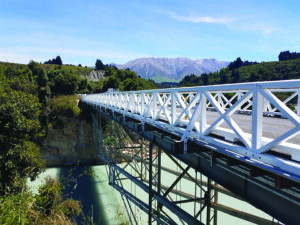
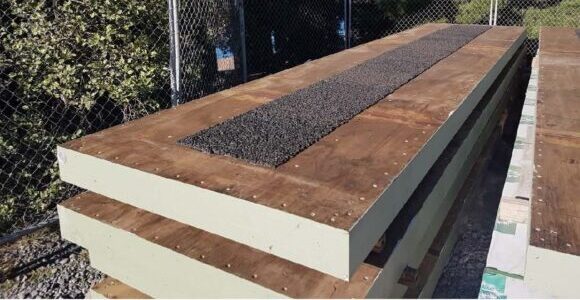
A PNGFP bridge at Rakia Gorge in New Zealand. Credit: PNGFP
PNGFP has sold its wood products domestically since 1954 and only branched out into exports a few years ago. But what started as a way to get access to more foreign currency soon became a lucrative sales channel in its own right, with the firm now exporting more than one-third of its plywood – primarily to Australia and New Zealand, where its products are mainly used in bridge decking, sub-floor construction, exterior cladding, bus flooring and highway noise barriers.
The experiment has been so successful that PNGFP is now planning to invest in additional kiln capacity and peeling lines to improve efficiency and reduce waste.
“I see growth in New Zealand,” Honey says. “Carter Holt Harvey, one of the biggest plywood producers (in New Zealand), has shut down. That will affect a lot of the retailers that need to buy our stuff, so they’ll be coming back through our distributor, we hope.”
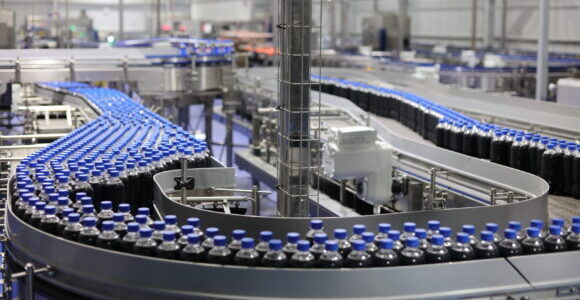
Pacific Industries is another longstanding PNG manufacturer with export ambitions. For more than 80 years, the food and beverage manufacturer had a single production facility in Rabaul. That all changed in 2024 when, six years after winning the exclusive PepsiCo bottling licence for PNG, it opened a PGK90 million can and bottle facility in Port Moresby.
The new facility in the capital now handles 70 per cent of Pacific Industries’ manufacturing needs, with some of the Rabaul plant’s capacity earmarked for a potential foray into the Solomon Islands.
“The shipping lanes circle around from Rabaul to Honiara to Fiji and then back, so Rabaul would take on capacity once we get that,” says Everett Chue, Director at Pacific Industries.
Positive impact
While most manufacturers are planning to increase capital expenditure in 2026, business growth isn’t necessarily the only motivation.
As a subsidiary of the Heineken Group, South Pacific Brewery is signed up to its parent company’s goal of achieving net-zero carbon emissions by 2030. In 2026, it completed upgrades to its Lae production facility, including installation of solar panels on the roof and expansion of warehouse capacity, according to Managing Director Ed Weggemans.
In addition to helping meet net-zero commitments, Weggemans says the upgrades will give the business the ability to meet any future increase in demand – including any flow-on boost from a final investment decision on the Papua LNG project, which is anticipated this year.
A version of this article was also published in the May–July issue of Paradise, the inflight magazine of Air Niugini. The full ‘Made in PNG’ special feature can be found here.