The local firm showing the way on waste management in Papua New Guinea and the Pacific
As more Papua New Guinean businesses consider how to integrate environmental and social standards into their operations, Business Advantage PNG speaks with one local firm that is already meeting best international practice.

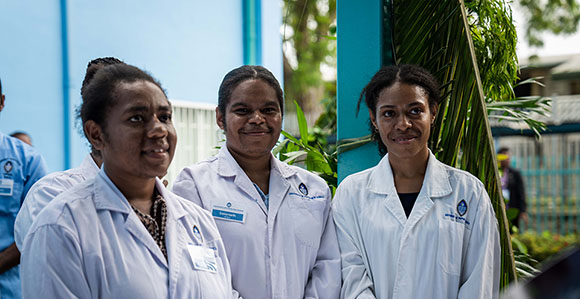
Workers from TWM Group. Credit: TWM Group
“More businesses need to learn and understand there is a level of ownership to their waste,” Kori Chan, Managing Director of TWM Group, tells Business Advantage PNG.
Last September, TWM secured a US$10.2 million investment from the International Finance Corporation (IFC) to fund construction of the country’s first integrated waste facility meeting international standards. The facility will enable TWM to service growing volumes of waste from various industries across PNG and the Pacific Islands region.
“There is huge potential for the waste management industry.”
This came off the back of TWM achieving full compliance with the IFC’s Performance Standards on Environmental and Social requirements. As part of the certification, TWM demonstrated that it identifies and manages environmental and social risks in line with global industry best practices, such as the World Bank’s environmental, health and safety guidelines.
Chan hopes TWM’s achievement will show the way to other Papua New Guinean businesses on waste management.
“It’s not just about putting it in the bin and it disappears. They need to understand where it goes and how it’s disposed of and whether it’s of the standard that’s acceptable to their business, industry standards and domestic and global regulations.”
Training the future
Outside of waste management, TWM Group has diversified in to environmental advisory services, industrial services, construction and renewables.
It is also branching into training and skills education. TWM is certified as a registered training organisation and is planning to launch a training program in the first half of 2026 focusing on much needed trades that compliment the different services it offers.
Additionally, it is looking at upskilling trainees through the Pacific Australia Labour Mobility (PALM) scheme. Australia’s Department of Foreign Affairs and Trade is pioneering a new stream of the PALM Scheme – traditionally used to recruit agricultural workers from PNG and the Pacific Islands – to focus on industry skills.
“Our plan is to aim to hit 250 [trained workers] in the next two years. We’re using this as a development pathway tool to develop PNG’s youth and skilled trade workforce, enhancing our nation’s capacity and capability.”
ESG on the rise
Looking more broadly, Chan believes attitudes are changing in PNG towards waste management and environmental, social and governance (ESG) issues.
“It’s been a journey to educate the wider population about what it means to actually live and practice this approach for waste management,” says Chan.
“I think more businesses are conscious now of the impact they’re having on the environment…There is huge potential for the waste management industry.”
Moreover, Chan sees huge foreign investment potential for businesses willing to rise to international standards like those of the IFC.
“Development partners are looking at high-impact investments and projects where they can work with the private sector to achieve [ESG] goals and outcomes,” says Chan.
For the industry to grow, Chan believes assistance is needed from the Papua New Guinean government and authorities.
“There’s still no national waste management policy in place,” he says.
“Unless we get the policy and the framework in place, the right regulation, the right force, the right stewardship programs and strong governance… Then you can start to support the service providers and the entrepreneurs that have that one big idea to help service that industry.”