
Keeping the traffic moving in Fiji
Fast-growing volumes of traffic are placing greater emphasis than ever on the need to maintain Fiji’s road transport infrastructure. The head of the government agency responsible outlines the challenges to Business Advantage Fiji.
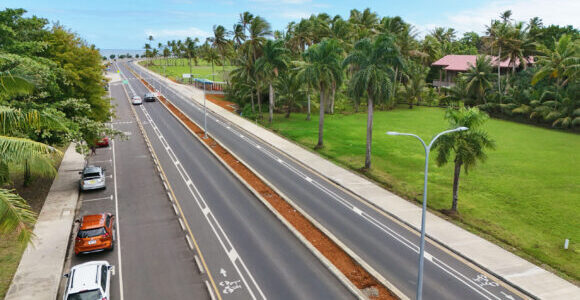
Climate-proof: a section of Queen Elizabeth Drive in Suva. Credit: Fiji Roads Authority
Fiji currently has some 1,828 kilometres (km) of sealed roads, 4,573 km of unsealed roads, 1,422 bridges and 32 jetties in active use, and their maintenance, upgrade and replacement is the responsibility of the Fiji Roads Authority (FRA).
Funded directly from the National Budget to the tune of just under F$370 million in 2026/7, the Authority’s priorities are clear, according to its CEO Apisai Ketenilagi:
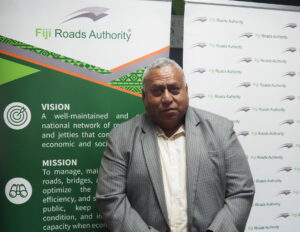
Fiji Roads Authority CEO Apisai Ketenilagi. Credit: BAI
“Before we start thinking about investment in new capital construction, it should be our priority first to maintain our existing network so it can be accessible to all … more than 50% of our budget is for maintenance.”
Two key factors make maintenance a particular challenge in Fiji, according to Ketenilagi: first, regular climate-related events such as flooding and cyclones and, second, the increasing volumes of traffic on the country’s roads, particularly on the main island, Viti Levu.
“Over the last ten years, traffic growth has been between five and ten per cent a year,” he tells Business Advantage Fiji. Heavier vehicle loads also have an impact on how regularly maintenance is required.
“Our major capital project right now is for the replacement of critical bridges,” says Ketenilagi. “We already identified about 20 of them and we have started with the first four: two in Suva and Nadi, and two in between Nadi and Lautoka.”
All four bridges are within the two busiest sections of Fiji’s national road network: the 193 km Queens Highway between capital city and major seaport Suva and the international airport at Nadi, and the road connecting Nadi to Fiji’s second busiest port at Lautoka.
These increasingly busy roads are not only vital conduits for commerce and logistics but are also essential for the country’s tourism sector.
New developments
The FRA plays an important role when new developments such as resorts or industrial centres are being planned.
“When development proposals come in, we have to comment on the relevant criteria developers need to fulfill when connecting their development to the existing road network,” says Ketenilagi. “They have to carry out a traffic impact assessment and we make a recommendation on how they should facilitate all those requirements.”
Like many organisations in Fiji, finding and retaining skilled workers is a challenge for the FRA, given the lure of working in the private sector or overseas. Skills, once lost, take time to replace.
“Road specialists require specialised training. They have to learn about pavement and road design, the materials to use and different types of construction,” notes Ketenilagi.
In part to add to its own institutional capacity, in April 2026 the FRA signed a partnership with Australia’s National Transport Research Organisation with the aim of improving the quality, resilience and long-term performance of Fiji’s road network.
This article appears in the 2026/27 edition of Business Advantage Fiji published in August 2026. Read the full edition here.