Amalgamated Telecom Holdings: driving growth in a mature market
Amalgamated Telecom Holdings (ATH) is the dominant player in Fiji’s telecommunications sector, operating mobile and fixed-line services, broadband and IT services across the Pacific. Business Advantage Fiji sat down with its CEO Ivan Fong to identify how it is achieving record growth in a maturing market.
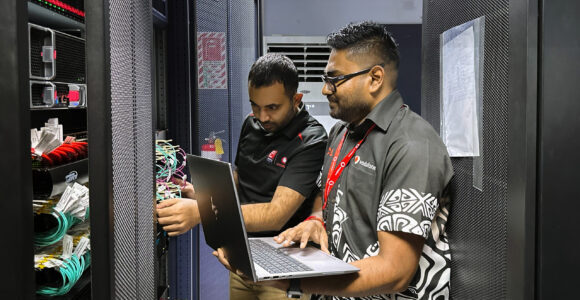
ATH’s largest costs of business are in sourcing bandwidth and equipment. Credit: Vodafone Fiji
Q
ATH celebrated a milestone in 2025, reaching F$1 billion in revenue. How was this achieved?
A
Fiji is a sizeable market, but with one million population and with the market maturing in terms of competition, our growth could have stalled. The board felt we should diversify our sources of revenue by operating in other Pacific Regional markets. Papua New Guinea (PNG), Samoa and our other Pacific markets are now generating more than 50 per cent of the group’s revenues today. For our board, it’s a big tick in terms of what they wanted to achieve.
While a single cable provides more than enough capacity for the country currently, it’s of national strategic importance to get Fiji’s connectivity shored up.
Q
What do you see as the underlying causes of the group’s equally strong profit result?
A

ATH CEO Ivan Fong. Credit: ATH
As primarily an internet business, the largest costs of business are always sourcing bandwidth and equipment. Getting some of these deals on a group basis has certainly moved the result in that direction.
A very large contribution has come out of our Vodafone PNG subsidiary as well. That business has started to cover its fixed costs and contribute positively to the results of the group.
Q
5G spectrum was released in Fiji in late 2025. Is there significant investment for the group moving to that next-generation technology?
A
Most of the operators in Fiji actually had the investments and supply contracts lined up to deliver 5G so, even before the ink dried on those authorisations, they were well along the way in terms of providing 5G.
At this stage, it is a very expensive piece of infrastructure to build out and provide. National coverage will be challenging because 5G requires a lot of other infrastructure to be in place, such as reliable power. In developing markets like Fiji, particularly in rural areas, that may not be available.
But for densely populated areas, 5G has provided a big boost in terms of capacity. There’s also been technological developments in our existing 4G networks. New MIMO [multiple in, multiple out] antenna technology is boosting throughput by about 30 per cent without that heavy 5G investment requirement.
Q
Low earth orbit (LEO) internet provider Starlink was licensed to enter the Fiji market at the end of 2023. What impact has it had?
A
With most Pacific markets now having experience with Starlink, people have figured out what the sweet spot for Starlink is, compared to what existing operators offer. We do compete somewhat on the retail front but one of the things our teams looked at was using Starlink to extend our own infrastructure.
Starlink has been a great solution to provide universal service to areas that didn’t receive good coverage before. In terms of the digital payments and digital ecosystems, it’s much easier to get that seamless service with a smartphone, so more recently our teams have been trying out extending the 4G networks using Starlink.
Initially, a lot of customers thought that Starlink would be real upfront competition, and it is somewhat, but I think a lot of corporates are finding out that there’s no substitute for fibre – it’s still many times more reliable than LEO services.
Q
Google has now connected two new undersea cables to Fiji. What do you see as the opportunities arising from this new infrastructure?
A
While the cables have landed, none of them directly provide any service into Fiji yet. The discussions still remain with Google and potentially others to look at connectivity into Fiji.
Fiji has access to fast internet and cheap capacity but, with the Southern Cross cable going out of service in 2030, we’ll be left with one cable (Southern Cross Next). I’m quite nervous about that.
One of the challenges for us is funding second and additional cables into Fiji. Each cable you land is a minimum US$30 million investment. While a single cable provides more than enough capacity for the country currently, it’s of national strategic importance to get Fiji’s connectivity shored up. So, a broader discussion has to happen with government and multilateral agencies about how to finance this.
This article appears in the 2026/27 edition of Business Advantage Fiji published in August 2026. Read the full edition here.