The 2026/27 Mining & Energy Survey: the results
For the first time, Mining & Energy has run a dedicated survey of executives from PNG’s extractive sectors to learn more about their exploration and broader investment plans – and to ask them about their operational challenges.
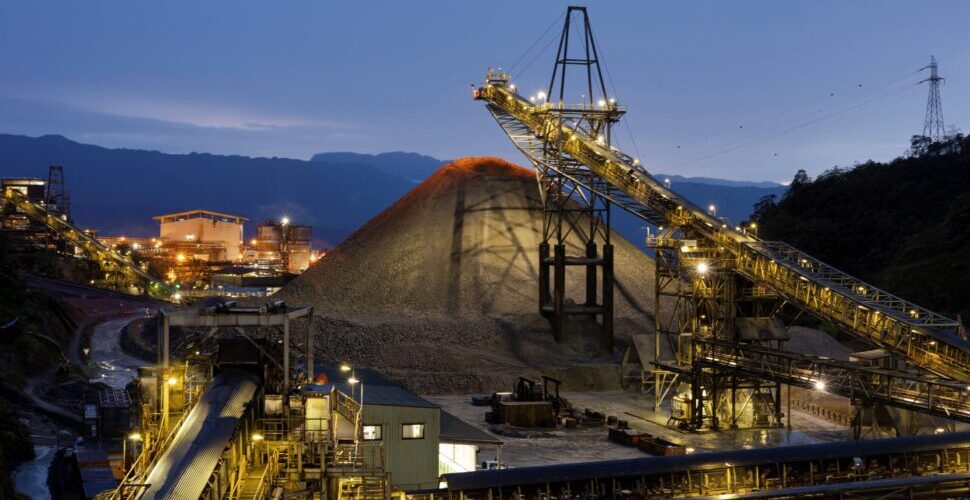
The Ok Tedi processing plant. Credit: Ok Tedi Mining Ltd.
Since 2012, Mining & Energy’s sister publication, Business Advantage PNG, has published its annual PNG 100 CEO Survey – a survey of the country’s top executives that is now widely recognised as the country’s leading business confidence survey.
This year, for the first time, Mining & Energy is introducing its own survey, which focuses exclusively on PNG’s resources sector.
Drawing on responses from producers and exploration/development companies across both mining and petroleum, the results of this inaugural survey point to a growing appetite for investment in exploration and production, despite some key challenges.
Exploration intentions
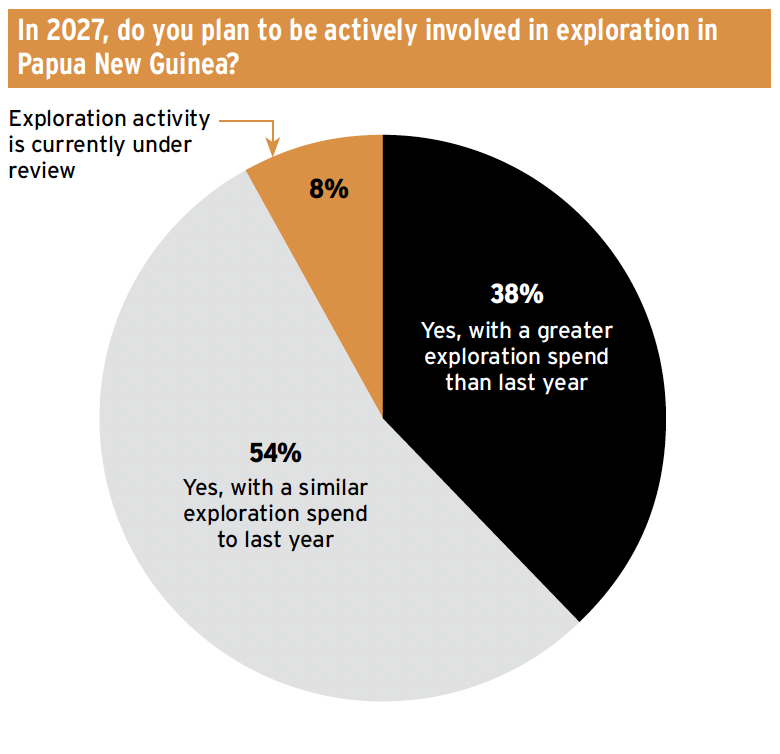
The survey began by asking respondents how active they plan to be on the exploration front in PNG in 2027, compared to 2026.
The responses were bullish, with 38 per cent of respondents planning to increase exploration expenditure in 2027 and 54 per cent expecting to hold spending at the same levels as 2026.
None of the respondents had plans to reduce exploration spending, although eight per cent said their exploration activity was currently under review.
Investment intentions
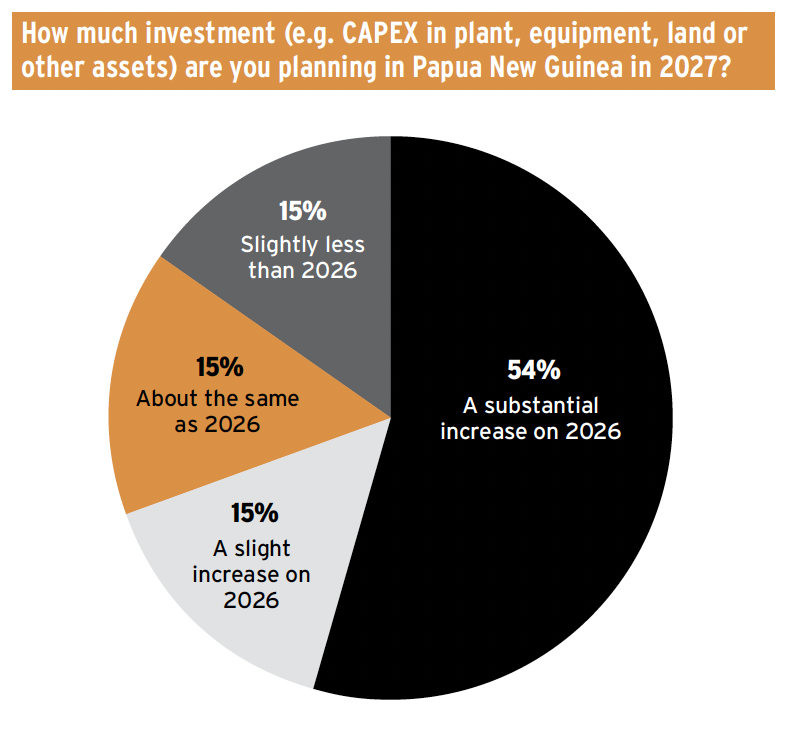
That appetite extended to broader investment plans, with 54 per cent of respondents planning a substantial increase in capital expenditure in 2027 compared to 2026.
A further 15 per cent said they were planning a slight increase in capital expenditure in 2027, while 15 per cent expected to keep capex at similar levels in 2027. Just 15 per cent anticipated a slight decrease in capex in 2027.
Recruitment intentions
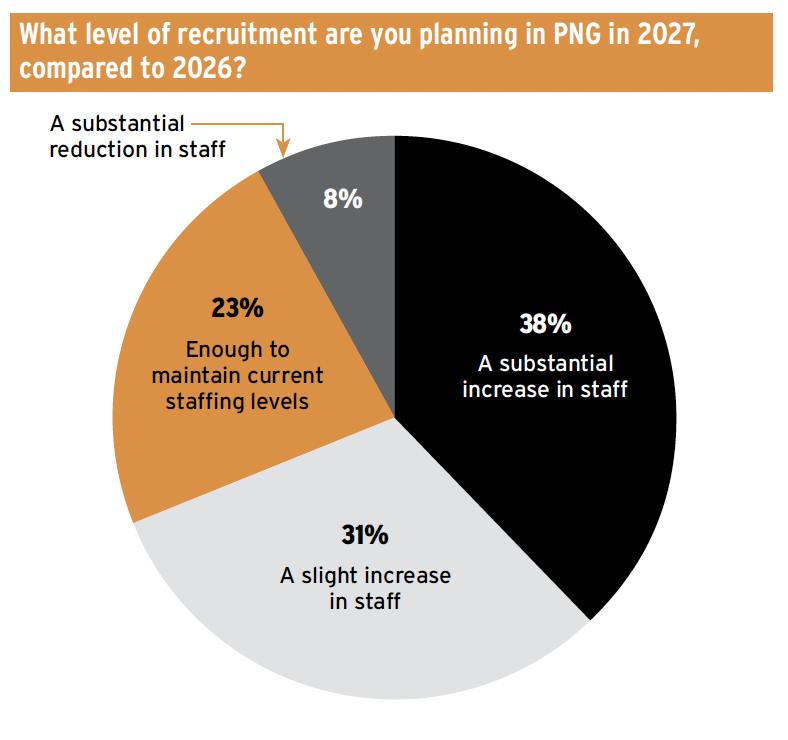
Hiring plans followed a similar pattern. More than two-thirds of industry executives said they plan to increase the size of their workforce in 2027 – with 38 per cent flagging a substantial increase in staff numbers and 31 per cent a slight increase. Twenty-three per cent of respondents expected to maintain current staffing levels, while eight per cent anticipated a substantial reduction.
Operational challenges
We asked the executives to give a score of between 1 and 5 to the various challenges facing their operations in PNG right now. A high score of 5 indicated a “mission critical” challenge to their business, while a 1 indicated a challenge was “not relevant”.
The respondents rated government capacity and high operational costs as the two biggest challenges, giving both an average score of 3.8. A shortage of expertise/skills and regulatory uncertainty both followed closely behind, with an average score of 3.5. Access to capital rounded out the top five with an average score of 3.2.
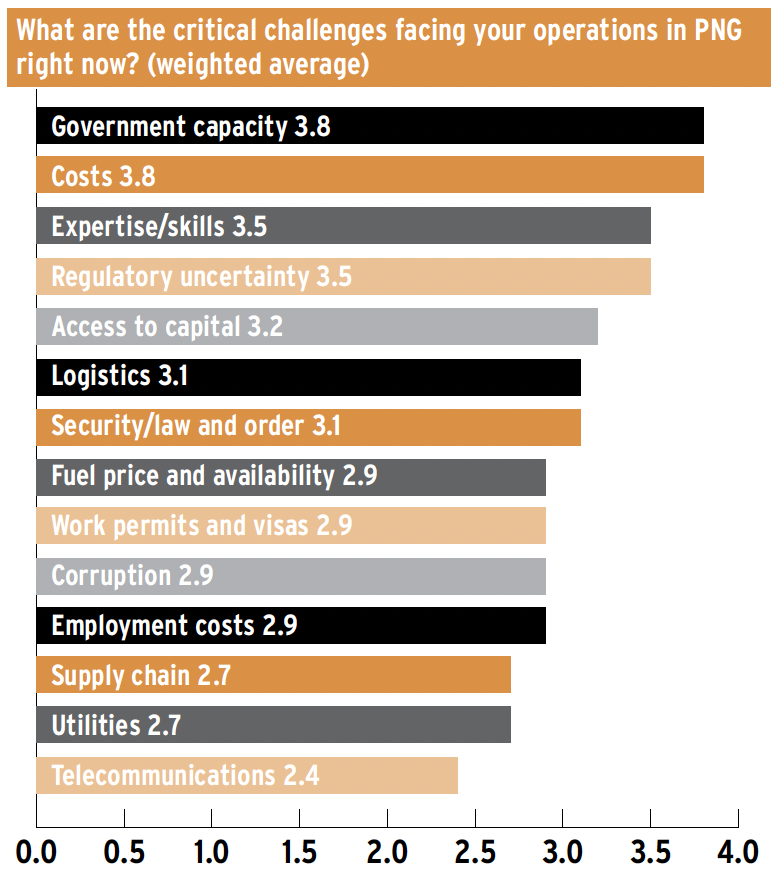
Access to capital was the most polarising: 38 per cent of respondents said it was mission critical to their business, while an additional 38 per cent said it was either moderately relevant or not relevant at all. This reflects the fact that accessing capital is a key issue for smaller exploration-stage companies that are ramping up their activities in PNG, but less critical for producers or larger companies that are able to fund activities without the need to raise capital.
Notably, telecommunications was rated as the least pressing of the 14 challenges nominated, with a weighted average of 2.4. Several respondents commented to Mining & Energy that their score would have been higher had we run the survey prior to April 2026, when licenses were finally issued to low-earth orbit satellite connectivity providers Starlink and OneWeb, which followed the resolution of protracted legal proceedings about Starlink’s licence in PNG’s National Court.
The Mining & Energy Survey was conducted by Business Advantage International between May and September 2026. The survey included senior executives from a representative sample of producers and exploration/development firms in PNG’s mining and oil and gas sectors. This article was first published in the 2026/27 edition of Mining & Energy, which you can read here.