State takes a stake as PNG’s first lime and cement project nears production
Pacific Lime and Cement has completed a number of construction milestones and locked in fresh backing from government and international partners in recent months. PLC Managing Director Paul Mulder tells Business Advantage PNG how these developments are shaping the countdown to first production.
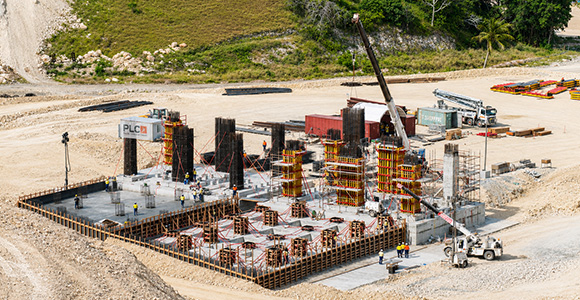
The Central Lime project’s Kiln 1 foundation civil works are progressing well, with the main reinforced concrete foundation substantially established. Credit: Pacific Lime & Cement
For the 1,500 people of the Kido landowner community, Port Moresby was once unreachable by road. But two new bridges built by Pacific Lime and Cement (PLC) have changed that: trucks are now travelling between the capital and PLC’s project site, a clear sign that phase one of Papua New Guinea’s first integrated lime and cement development is nearing production.
“The bridges and roads are completed,” PLC Managing Director Paul Mulder tells Business Advantage PNG. “There are two 60 tonne-capacity bridges – a 15-metre span bridge and a 51-metre span bridge that connect the Kido people to Port Moresby for the first time ever.”
“Now that we’re dual-listed, we’re starting to see a fair amount of interest from the PNG market.”
The phase-one Central Lime Project sits 35 kilometres northwest of Port Moresby, where first lime production remains on track for the first half of 2027.
Foundations for the project’s first two kilns, which will together produce up to 1,200 tonnes per day of quicklime, were recently poured. Some 369 foundation piles, each 40 metres long and weighing more than 20 tonnes each, were recently delivered to site, where they will be used to extend the project’s private international wharf by 180 metres with a minimum depth of 10.5 metres. A construction camp with beds for 300 workers is now fully operational.
Moreover, PLC recently signed a memorandum of understanding with Dirio Power, a subsidiary of the state-owned Mineral Resources Development Company, to build a transmission line to Dirio’s nearby 45 MW gas-fired power station. “We’ve already fleshed out several design options with Dirio and are working through how we best deploy the infrastructure to support phase one and two of our project – because the power line will have the ability to service both,” Mulder says.
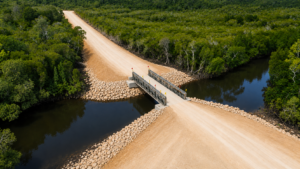
As part of the ML526 Access Road completion, also known as the Mulder Highway, the Geva Bridge helps link the Kido community to Port Moresby. The Geva Bridge was named by the Kido landowners. Credit: PLC
Phase two, the Central Cement Project, will turn limestone into cement. Both phases sit within a Special Economic Zone that PNG’s government licensed in 2021 to encourage downstream processing industries in the area. Mulder says a final investment decision on phase two is being targeted “by the end of this year,” to be followed by a two-year construction period.
PNG made
Cement is central to what Mulder calls a “nation-building” project. PLC is currently working with the government on a policy that he says is designed “to ensure that local, more cost-effective, equivalent or better-quality cement and lime manufactured domestically that will displace 100 per cent of imports.”
The importance of the integrated project to PNG is reflected in the 27 July decision by state-owned Kumul Mineral Holdings (KMHL) to exercise its right to a 13 per cent stake in the Central Lime Project for US$16.3 million (K72 million). KMHL has the right to obtain an additional 5 per cent stake in the lime project for US$6.8 million and can separately acquire up to 30 per cent of the Central Cement Project ahead of the phase two FID.
The International Finance Corporation has also been involved in the project as a strategic partner since late 2025. “They’ve been working with us on updating the bankable feasibility study, the construction bids, the market study, and finalisation of the environmental and social elements of the project,” Mulder says. “That’s been going extremely well.”
Local participation
The institutional confidence in PLC’s lime and cement project is mirrored in its performance on the stock market. The firm was already listed on the Australian Securities Exchange before adding a secondary listing on PNG’s national exchange, PNGX, in December 2025.
David Lawrence, Chairman of PNGX Group, tells Business Advantage PNG that PLC is now the exchange’s second most-traded stock, behind BSP Financial Group. He notes the firm is planning a separate listing for the cement project, which he believes will further underpin its success: “Getting local ownership plays into that social license to operate.”
Mulder has also observed an appetite from domestic investors. “Now that we’re dual-listed, we’re starting to see a fair amount of interest from the PNG market – participants backing the story of nation building,” he says.