Economic update: Papua New Guinea’s ‘year of reset’
With improved export receipts and the prospect of major resources projects starting in 2026, Papua New Guinea’s economy is set for a sustained period of growth. Andrew Wilkins speaks with business leaders in the country about their expectations for the year ahead.

PNG Ports has secured financing from the European Investment Bank and the French Development Agency to upgrade the port in Rabaul, East New Britain. Credit: PNG Ports
Papua New Guinea’s economy is expected to grow by 4.0 per cent in 2026, according to the PNG Government’s National Budget. The International Monetary Fund’s own growth expectations align with those of the budget, while the Asian Development Bank is forecasting 3.6 per cent GDP growth in 2026.
Underpinning this growth will be strong prices of key export commodities – and not just gold and copper, which both hit all-time highs in early 2026.
Cocoa and coffee have also been trading at historically high prices these past two years, delivering increased revenues to the agriculture sector, which supports the bulk of PNG’s largely rural population.
Indeed, Bank of Papua New Guinea figures reveal that deposits into PNG’s banks from businesses in the agriculture, forestry and fisheries sectors almost doubled between June 2023 and June 2025.
Both cocoa and coffee are expected to remain above historical averages this year, while the price of PNG’s largest single agricultural export, palm oil, is expected to remain steady.
However, growth in the economy is not uniform. Many businesses focused on serving the domestic market, such as retailers and manufacturers, are reporting patchy trading conditions, with their margins challenged by a depreciation in the kina (which increases the costs of imports) and a higher minimum wage (introduced in January this year).
“Growth in 2025 has been a commodity price story rather than about the expansion of the economy per se, reinforcing the opportunity to build on this foundation,” Andrew Betteridge, Country Head of ANZ in PNG, tells Business Advantage PNG.
In the case of Papua LNG, ANZ’s Pacific Economic Outlook suggests that GDP growth this year could jump by an additional one to two percentage points should FID occur.
Impact of Papua LNG
The GDP growth predictions above do not factor in the anticipated economic boost that would follow final investment decisions (FIDs) for the TotalEnergies-led Papua LNG project and Twinza’s smaller Pasca A offshore gas project. Both gas projects are expected to reach FIDs this year.
In the case of Papua LNG – potentially the second-largest foreign direct investment ever made in PNG – ANZ’s Pacific Economic Outlook suggests that GDP growth this year could jump by an additional one to two percentage points should FID occur.
Businesses will be anticipating the successful completion of the government-organised development forum, expected in the first half of this year. This critical milestone, once achieved, could trigger an investment by TotalEnergies and its partners in excess of US$14 billion, spread over the project’s four-year construction period.
In its first 12 to 18 months, most of the project activity is expected to take place offshore.
However, Rio Fiocco, President of the Port Moresby Chamber of Commerce & Industry, tells Business Advantage PNG that should FID go ahead this year, he would expect local business activity to start picking up soon after, with hotels, airlines, machinery suppliers and financial institutions likely to be busier.
BSP Financial Group’s CEO Mark Robinson predicts the biggest immediate effect will be on overall business confidence.
“Businesspeople will foresee a healthier position for the currency, for the economy as a whole, for GDP growth, for government finances, and so forth,” he says. “It will give them the confidence to make their own investments.”
Forex relief
The improvement in the availability of forex has been a big positive in the past year.
Forex shortages have plagued businesses in PNG for the past decade, slowing payments, constraining investment and – for international investors – delaying the repatriation of profits.
As Kina Bank CEO Ivan Vidovich observes, the improvement in forex supply has been “a very healthy and well appreciated development.”
The progress has been largely due to more regular and larger interventions by PNG’s central bank, supported by an International Monetary Fund program, as well as the improved export receipts.
Although forex shortages have declined, businesses in PNG still face many other constraints.
While some fluctuations in forex supply can still be expected, Vidovich suggests that PNG may be entering a phase in which PNG’s forex system relies “less on central bank interventions and more on the inter-bank market – which we’re now set up for.”
The forex improvement has also helped the country’s superannuation funds.
“Between last year and this year, we’ve been able to invest more money out of the country because of the relaxation of forex,” says Rajeev Sharma, CEO of Nasfund. “That, allied to better returns on our portfolio, has been a great help.”
Despite the improvement in forex availability, the purchasing power of PNG’s currency is weakening.
During 2025, the kina fell by 5.1 per cent in value against the US dollar, 12.28 per cent against the Australian dollar and 16.54 per cent against the euro. The prevailing view is that it may have further to fall.
“Strong price prospects for key mineral exports such as gold, copper and silver are likely to continue supporting forex market activity in 2026,” BSP’s Mark Robinson tells Business Advantage PNG.
“Ongoing geopolitical uncertainty has also boosted demand for safe-haven assets, underpinning export receipts for PNG’s gold sector.”
Impediments remain
Although forex shortages have declined, businesses in PNG still face many other constraints.
“Many of the challenges reported by our provincial chambers remain persistent,” notes Ian Tarutia, President of peak industry body, the PNG Chamber of Commerce & Industry.
“The high cost of doing business is primarily due to unreliable utilities such as power, water and telecommunications connectivity.
“Additionally, currency depreciation, slow GST refunds, and security and law and order issues are significant concerns.”
John Byrne, President of the Lae Chamber of Commerce and Industry, argues that power is the most pressing issue overall, adding that “it affects the whole community.”
He notes that state utility PNG Power Ltd’s turnaround plan will require significant government support to be delivered.
These concerns expressed by Tarutia and Byrne are confirmed by the 2026 results of the annual PNG 100 CEO Survey run by Business Advantage PNG in partnership with Westpac.
Progress areas
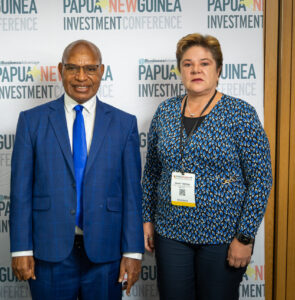
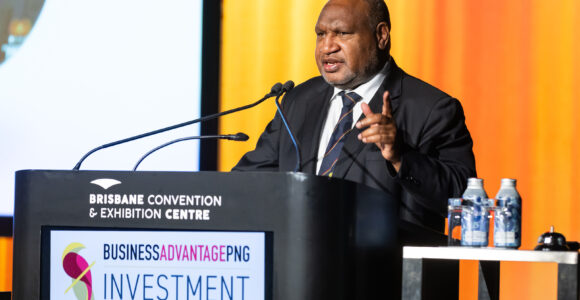
Richard Maru, Minister for International Trade and Investment, and Zanie Theron, Partner-in-Charge of KPMG’s South Pacific Practice, at the 2025 Business Advantage PNG Investment Conference. Credit: Stefan Daniljchenko/BAI
While electricity remains a challenge, progress has undoubtedly been made in telecommunications, with telcos Digicel PNG, Vodafone PNG and Telikom PNG all expanding their networks.
While PNG is yet to license Starlink’s Low Earth Orbit satellite service, wholesaler PNG DataCo continues to build out PNG’s connectivity backbone, the National Transmission Network.
And, in late 2025, it was announced that Google will play a role in constructing three domestic undersea cable networks, to be funded by Australia under the 2025 Pukpuk mutual defence treaty with PNG.
As Zanie Theron, Partner-in-Charge of KPMG’s South Pacific Practice, observes, the long-term impact of the Pukpuk Treaty is likely to be positive and far-reaching.
“With its construction projects needing to meet Australian standards and its requirement for specialist service providers, it will provide an additional stimulus to the economy,” she tells Business Advantage PNG.
Infrastructure boost
Meanwhile, capacity at the nation’s ports continues to improve, thanks to ongoing investments in capacity by both PNG Ports Corporation, the state entity that manages the country’s 15 key ports, and international port operator ICTSI.
“The country is in far better shape for the projects going forward, given that so much of this infrastructure has been built in response to the PNG LNG construction boom of 2010 to 2014,” says PNG Ports Corporation’s CEO Neil Papenfus, who experienced the last boom first hand in a stevedoring business. “We’re ready to take these opportunities on board.”
One government initiative aimed at increasing capacity further, and encouraging downstream processing, is the development of Special Economic Zones across the country.
Five SEZs have already been licensed, providing tax incentives to both their developers and, potentially, their future tenants, with many more in preparation, including PNG Ports’ planned Lae Industrial Park.
A sovereign wealth fund, finally
While PNG’s physical infrastructure is undoubtedly in better shape to accommodate major projects, there is one piece of economic infrastructure still missing: the long-awaited Sovereign Wealth Fund (SWF). This fund would receive and invest surplus funds from PNG’s resources projects to provide greater long-term economic and currency stability.
With the debt recently repaid on PNG’s first gas project, PNG LNG, and Papua LNG looking imminent, work on an SWF that meets international standards is moving ahead.
“The government has shown a strong commitment to making the SWF operational, and we are working diligently to achieve this goal by the end of the year,” Ian Tarutia, who leads the government’s technical advisory team on the fund, tells Business Advantage PNG.
“Our mission is to ensure that the legislative, institutional, administrative and governance structures for the SWF are effectively established before it becomes operational.”
Rising baseline
While many business leaders are looking forward to news of new greenfield resources projects this year, CreditBank PNG’s CEO Danny Robinson points out that there is already a rising baseline of economic activity from the sector’s existing projects.
“The Porgera gold mine has had record first half results. We know that Kainantu and Lihir are spending an enormous amount of money in upgrading and increasing their production. All of those things are good for the economy and create employment,” he says.
POMCCI’s Rio Fiocco also observes an increase in economic activity, pointing to the “construction activity and the work towards PNG entering Australia’s National Rugby League competition in 2028, as well as the developments related to Special Economic Zones.”
This piece was first published in the 2026 edition of the Business Advantage PNG Annual. You can read the full issue here.