Key milestones checked off at Papua New Guinea’s first lime and cement project
Pacific Lime and Cement ended 2025 with a flurry of announcements, including agreements with the PNG Government and IFC. PLC Managing Director Paul Mulder tells Business Advantage PNG why these agreements are so important to the success of its Central Cement and Lime Project.

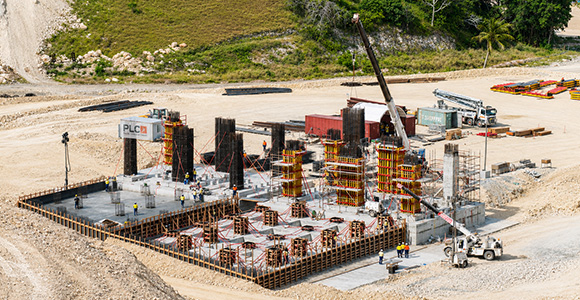
Fuel storage, workshops, and laydown areas at the Central Cement and Lime project. Credit: PLC
Key developments have kept coming at Pacific Lime & Cement (PLC) since it made a final investment decision (FID) on its phase-one Central Lime Project last August.
In a busy end to 2025, the company reached a Project Development Agreement (PDA) with the PNG Government, secured a strategic partnership with the International Finance Corporation (IFC), and became the 12th company listed on PNG’s national stock exchange, PNGX.
Aligning all stakeholders

PLC’s Paul Mulder
The Project Development Agreement provides the legal and policy framework for the lime project and the phase two Central Cement Project, located 35 kilometres northwest of Port Moresby. Legally binding under PNG law, it sets out the project’s fiscal, equity and regulatory terms.
“It has aligned all the parties involved, joining us at the hip as we move forward with our nation-building project,” PLC Managing Director Paul Mulder tells Business Advantage PNG.
The PDA gives the PNG Government the right to acquire a 13 per cent stake in each of the project’s two main operating entities – Quicklime and Cement. Up to 8 per cent of this stake will be allocated to project-area landowners and the Central Provincial Government. In addition, PLC will directly provide a 2 per cent free-carried equity stake in both entities to local landowners. The PNG Government also has the option to acquire an additional 5 per cent in each project.
It also confirms the granting of full Special Economic Zone (SEZ) status for the downstream elements of the project, including quicklime and cement production. SEZ benefits, which apply until at least 2035, will include corporate tax concessions and relief from import duties. Raw limestone production and sales will be excluded from the SEZ and subject to ordinary taxation.
Strong backing
Another milestone late last year was the entry of the International Finance Corporation, the private-sector arm of the World Bank Group, as a strategic partner for the cement phase of the project.
“We’ve equity funded the entire development, so we don’t have any risk of project finance hanging over our head”
The IFC will advise PLC on strengthening the project’s technical, commercial and environmental foundations. This includes assessing its Environmental and Social Management System and recommending improvements to support compliance with IFC Performance Standards, a prerequisite for multilateral and global financiers.
“They have spent a long time examining our social licence and what we’re doing with landowners, as well as the economic and SDG [Sustainable Development Goals] benefits that a cement plant will bring to PNG, given its reliance on imports,” Mulder says.
Meanwhile, PLC’s secondary listing on the PNGX will also make it easier for Papua New Guineans to invest in its project, complementing its existing listing on the Australian Securities Exchange.
“Having a dual listing gives easy access to super funds, mums and dads and other parties [in PNG] who would like exposure to this nation-building opportunity,” Mulder says. “It’s going to be something that’ll be very attractive.”
Building a domestic cement industry
Construction is underway on the phase-one Central Lime Project, with completion expected in early 2027 and PLC already “lining up the major off-takers for the product,” according to Mulder.
The first major contract was announced in February, with gold producer Newmont signing a cornerstone contract for approximately one-third of the project’s production capacity.
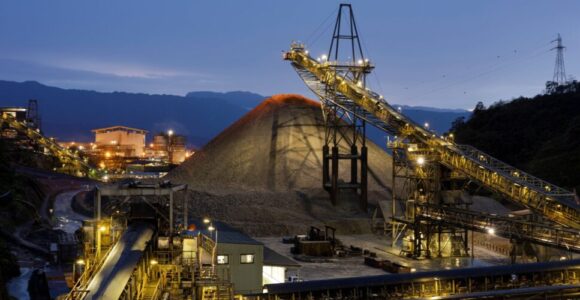
Once completed, the Central Lime Project will include a limestone quarry and two kilns capable of producing a combined 1,200 tonnes per day (tpd) of quicklime, with the possibility of scaling up to 3,600 tpd within five years.
Meanwhile, an FID on the phase-two cement project is being targeted “by the middle of 2026,” with construction expected to take two years.
PLC is committed to supplying all of PNG’s domestic lime and cement from the project, and it expects to cut in half the retail price of cement in Port Moresby, Mulder said in a previous interview with Business Advantage PNG.
Looking ahead, PLC is also planning a third phase which would see it move further down the value chain into concrete, casting and bricks – deepening domestic industrial capacity.
“We’ve equity funded the entire development, so we don’t have any risk of project finance hanging over our head,” Mulder says.
“At the same time, we can either incrementally grow with our cash flow; or we can accelerate, using that cash flow as collateral, to further expand the [three] stages of the project.”