Economic update: how is Fiji riding the waves into 2027?
While the global fuel crisis is having an impact on Fiji, business leaders express confidence in the country’s economic trajectory, as it plans for new elections and a surge in investment in infrastructure.
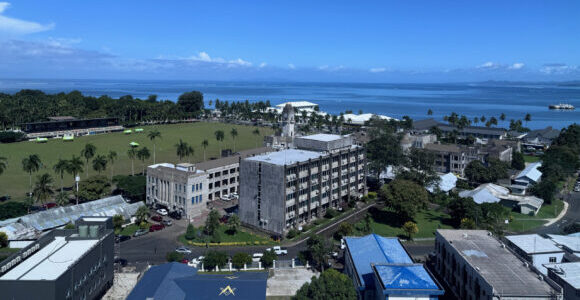
Government buildings overlooking Albert Park in Fiji‘s capital, Suva. Fijians will vote in national elections before the end of January 2027. Credit: BAI
Looking beyond the impact of higher global oil prices in 2026, Fiji’s economy has been travelling well.
“I think Fiji’s got a very strong growth future, for three reasons,” Sohaib Mahmood, Country Head for Australian bank ANZ, tells Business Advantage Fiji. “Tourism is growing – the resorts are incredibly busy. That’s your main earner. Then, there’s the well-placed aid and grants from international agencies. If you combine both of them with remittances, those are the main revenue sources.”
The large diaspora of Fijians working overseas sent over F$1 billion home in 2025.
The expansion of Fiji’s economy since its textbook reopening to tourists post-Covid, has led to a surge of private sector investment aimed at upgrading existing inventory and expanding capacity to meet greater demand, both in tourism and real estate.
The skyline and shoreline of Fiji’s capital, Suva, is undergoing some significant changes, as developers aim to address a long-term shortage of office space and hotel rooms.
Fijian Holdings’ 18-storey FHL Tower opened in Suva in October 2025 and is already fully tenanted. Meanwhile, Carpenters Fiji’s 12-storey MHCC Tower is one of two major developments by the Malaysian-owned group expected to open in 2027 – the other being the 178-key Hilton Garden Inn on Suva’s waterfront.
“This is the first new hotel opening in Suva for some years, so there’s a lot of excitement around us coming,” Carey Osbourne, Cluster General Manager for Hilton in Fiji, tells Business Advantage Fiji.
While the Hilton Garden Inn is aimed more at the business traveller and locals, there are many more properties currently under development across the country aimed at the million-plus tourists who visit Fiji each year.
These include Yavu Collective’s F$250 million five-star Sofitel Vatu Talei resort on Denarau Island plus two new four-star hospitality assets worth a combined F$130 million, a Radisson Blu Mirage Resort on Naisoso Island and a One&Only Resorts & Private Homes property in the Yasawa Islands.
Better business environment
The inaugural Fiji 100 CEO Survey, conducted by Business Advantage International for this publication, confirms fuel price and availability as the number one issue facing Fiji businesses, followed by a shortage of expertise/skills, excessive red tape and inflation.
While there is very little Fiji can do about global oil prices, other factors – such as improving the enabling environment for business – are more within its control.
“What we’re doing is trying to work with government to ensure that we reduce the cost of doing business where possible,” says Eldon Eastgate, President of the Fiji Commerce and Employers Federation, which is lobbying government to build on its recent progress with the digitising of approvals and licensing, improving coordination across government agencies and achieving greater regulatory transparency and consistency.
To help improve matters, Fiji’s government has already created a taskforce to fast-track investment projects, while investor-facing agencies Investment Fiji and the Ministry of Immigration are working together to reduce the time it takes to issue investor permits.
One thing businesses in Fiji haven’t had to worry about recently is the cost of borrowing. The Reserve Bank of Fiji’s Overnight Policy Rate has been running at 0.25 per cent since March 2020.
“The reason why interest rates are low in Fiji is that there’s ample system liquidity – there’s plenty of money in the system for the banks to lend,” explains Maikash Ali, Acting Country Head in Fiji for Bank South Pacific (BSP), the Pacific’s largest bank. “Now, that liquidity has been tightening, and there may be downside risks to that … At some point in time, the rates will have to go up.
“It’s been good for the country. It’s been good for borrowers, it’s given them the confidence to borrow, but it cannot last forever.”
As noted in the CEO Survey, Fiji’s employers are still facing skills shortages – a symptom of a post-COVID “brain drain” as skilled workers have sought opportunities overseas.
“A major challenge for us at the moment is the productivity of the workforce and the availability of skilled labour,” notes Cate Pleass of bottled water manufacturer Pleass Global, echoing the comments of many employers we spoke to for this publication. “It’s a huge challenge. A lot of skilled labour has left the country and gone to Australia and New Zealand.”
Fiji has been importing workers from Bangladesh, India and the Philippines to compensate in skills areas such as digital workers and analysts but has a challenge accommodating significant numbers of expat workers.
Many employers have their own in-house training programs but, ultimately, the country will need to develop its own skills base through more investment in technical skills and training.
While the fiscal and regulatory environment for business is relatively stable in Fiji, two pieces of legislation currently being drafted are likely to have relevant implications. A new Employment Relations Act is seeking to better define workers’ rights and employers’ responsibilities, while the Commercial Use of Marine Areas Act is a pioneering attempt to balance the usage needs of commerce with those of iTaukei (indigenous) landowners. Meanwhile, a commission was set up in March 2026 to review the country’s 2013 Constitution, and the review was in progress at the time of writing.
Infrastructure focus
Improvement in infrastructure is another area that could greatly improve Fiji’s business environment.
Fiji’s infrastructure situation is by no means all negative. The country’s telecommunications infrastructure – already the best in the Pacific – continues to improve. In 2025, Fiji became part of tech giant Google’s Pacific Connect Initiative with the landing of Google’s Tabua and Bulikula undersea cables in Fiji. Meanwhile, the rollout of 5G services commenced in late 2025 following the issuing of relevant spectrum.
In aviation, it has a world-class airline in Fiji Airways, and its international airport in Nadi has established itself as one of the leading transit airports in the Pacific region.
“I’m not so concerned around our aviation sector, but we need some serious thoughts around how to improve ports and shipping and roads from an infrastructure perspective,” says Eldon Eastgate. “Our heavy reliance on fossil fuel generators needs to be looked at too.”
Fiji’s National Budget for 2026/7 contained some good news in this regard. Fiji’s Minister for Finance, Commerce and Business Development, the Hon. Esrom Yosef Immanuel, confirmed capital expenditure on infrastructure would be increasing, with F$876 million budgeted for the 2026/7 financial year.
He outlined a pipeline of public infrastructure projects worth some F$5 billion, including for renewable energy transition, port infrastructure redevelopment and airport expansion.
“Capital spending will significantly increase as we progress from design and tender stage to actual implementation of the above projects,” he said. “We target to double our capital spending in the short-to-medium term.”
“Fixing the infrastructure is important for any country to grow. You can’t go and start business if the water is not there,” comments Jaoji Koroi, Group CEO at local investment fund Fijian Holdings.
“It may be costly over a period of time but I think it needs to be prioritised and done. Fiji has a lot of potential in tourism and associated areas, in agriculture, but we really need these basic building blocks to be invested in.”
Elections
While the exact date wasn’t available at the time of publication, Fijians must go to the polls to elect a new national government by January 2027, when the current government completes its four-year term. While the country’s hotels can expect to be a little busier, most businesses are taking a “wait and see” approach regarding the election period.
“In my experience, three to six months leading into an election, the investment activity slows down a little bit,” notes Maikash Ali.
“If you look at past trends, pre-election it’s pretty soft and subdued,” adds Eldon Eastgate. “With our history with coups and so forth, people do tend to tread lightly leading up to elections. Once elections are done and the results are known, generally it’s back to business as usual.”
While Reserve Bank projections suggest the pre-oil crisis levels of growth may not return until 2028, the fundamentals of Fiji’s economy remain strong.
“I personally think that it’ll be reasonably stable. I don’t see big growth. I don’t see big decline. We are only a three, three-and-a-half hour hop away from New Zealand and Australia and a safe and proven market,” says BSP’s Maikash Ali. “I am quietly optimistic about the future.”
Fiji and the global fuel crisis
As it has around the world, the rise in the price of oil caused by conflict in the Middle East has undoubtedly had an impact on businesses in Fiji and on the country’s economy more broadly.
Higher fuel prices undoubtedly had a significant impact in the first half of 2026, with the Reserve Bank of Fiji recording an annual inflation rate of 3.9 per cent in May, on the back of rising transport costs. This is a marked reversal from the -1.53 per cent decline in inflation recorded over the preceding 12 months.
The consequent slowing of retail activity and a softening of momentum in tourism (Fiji’s largest economic sector, which accounts for around 40 per cent of its GDP), has led the Reserve Bank of Fiji to revise down its real GDP growth expectations for 2026, from 3.0 per cent to 1.5 per cent.
“While visitor arrivals remain supportive of economic activity, the pace of expansion has slowed, weakening one of the key drivers of growth,” said the central bank’s Governor Arrif Ali in a June statement.
“These factors are expected to dampen private consumption and investment activity, resulting in a slower pace of economic growth in 2026 than previously projected.”
While international fuel prices were already easing at the time of writing (June 2026), any impact on domestic fuel prices will take time to flow through, with the Fijian Competition and Consumer Commission’s regulated fuel price operating with an approximate two-month lag.
In the meantime, direct budget support from multilateral agencies such as the Asian Development Bank and bilateral donors Australia and New Zealand is expected to help Fiji’s government ease the pressure on households and businesses affected by higher fuel prices.
While its aviation and transport sectors remain heavily dependent on fuel oil, it is worth noting that the country is less reliant on it for electricity generation.
“Today, depending on hydrology, approximately 45 to 55 per cent of Fiji’s electricity generation comes from renewable sources, primarily hydroelectricity, with the remainder from thermal generation,” Fatiaki Gibson, Chief Executive Officer of state-owned power provider Energy Fiji, tells Business Advantage Fiji. “This renewable base has acted as an important buffer against the full impact of global oil price shocks.”
Opportunities to come
One of the key opportunities Fiji has in coming years is to build out its economy beyond its world-class tourism sector. Some progress has been made in this regard, with business process outsourcing a recent success story. Fiji’s position as a services and logistics hub for many of the Pacific’s other island nations is also leading to growth in transshipment activity.
“There’s a whole range of exciting opportunities in Fiji beyond tourism,” Michael Nacola, Managing Director of BSP Life, which manages a F$1.25 billion investment portfolio, tells Business Advantage Fiji.
“Look at commercial agriculture, for example; look at Fiji being the hub of the Pacific, from an aviation and the seaports perspective; look at Google’s now-landed cable into Fiji and the opportunities that can be catalysed in the ICT and data centre space; look at renewable energy.
“There’s a wide range of new industries that can be scaled up pretty rapidly, which is critical to diversifying Fiji’s economic base.”
“I think if we had a concentrated effort towards agribusiness, there is a huge opportunity here,” agrees Sohaib Mahmood, the recently appointed Country Head in Fiji for Australian bank, ANZ. “If you just fly from Suva to Nadi or across the other islands, you’ll see a lot of undeveloped land.”
Given how close Fiji is to the big economic centres on Australia’s east coast, Mahmoud thinks Fiji could also expand its physical trade.
“I don’t see why there couldn’t be more manufacturing here if the government supports it and encourages it. There’s a lot of opportunity here.”
For Kamal Chetty, CEO of Investment Fiji (Fiji’s investment promotion agency), it is about attracting the right kind of investors to fit with Fiji’s profile as a country.
“We need to ensure the technology and investment we bring into the country supports sustainable growth. That means, they must not overuse our natural resources or put excessive strain on local capacity. In our view, the right investors are those who bring efficiency and smarter ways of operating that allow us to grow without depleting what we have.”
For Chetty, targeting this kind of investor aligns with Fiji’s broader push to diversify its economy beyond traditional sectors: “The goal is not just more investment, but investment that opens new industries, builds local capability, and reduces the country’s exposure to any single source of growth.”
This article appears in the 2026/27 edition of Business Advantage Fiji published in August 2026. Read the full edition here.