Fiji: improving investment climate, labour shortages persist
Late last year, Andrew Wilkins visited Fiji’s major business gathering, TOPEX, to get an idea of how the economy of the region’s tourism powerhouse is performing.

Founded in 1961, the Fiji Commerce and Employers Association is celebrating 65 years representing the country’s private sector. Credit: BAI
As Fiji enters a likely election year, business activity continues to be underpinned by its strong tourism sector, with government continuing key reforms to unlock further investment and encourage greater diversification across its economy.
Fiji’s GDP growth in 2025 was around 3.4 per cent, according to the Reserve Bank of Fiji (RBF), and it is projected to run at 3.0 per cent this year. Inflation is expected to remain low (2.5 per cent), as are interest rates (4.48 per cent).
“Our anticipation, and also our hope, is that the economic momentum that’s been built up just continues.”
According to the November 2025 assessment by the RBF’s Macroeconomic Committee, “Consumption activity remains strong, sustained by higher incomes, remittances and government spending …
“The investment climate is improving, evidenced by an increase in the uptake of private and public sector construction projects reflected in the increased number and value of building permits issued, higher value of work done, and increased lending.”
“We believe GDP growth of three per cent is the baseline projection for 2026 with the risk tilted on the upside,” ANZ’s Senior Pacific Economist, Kishti Sen, wrote earlier this month. “If some of the larger projects in the residential, commercial and industrial space start early in the year, Fiji will do better than 3 per cent.”
Tourism’s big build
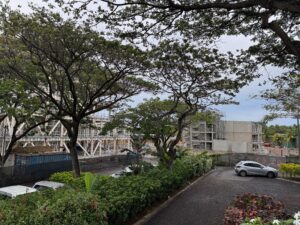
The Vatu Talei six-star hotel development under construction on Denarau Island. Credit: BAI
Much of the building and construction is aimed at addressing capacity constraints in the tourism sector, which continues to perform strongly, with roughly a million visitors coming to the island nation in 2025.
“Tourism is thriving and has catalysed a number of major construction projects that are now well advanced,” Michael Nacola, Managing Director of BSP Life, tells Business Advantage.
These include several projects BSP Life is involved in, including Vatu Talei – a F$250million development on Denarau Island, which will be the country’s first six-star offering (set for soft opening at the end of this year), and the Kerzner Groups’ first One&Only resort in Fiji, located in the Yasawa Islands (set to open in 2029).
“These developments support Fiji’s positioning as a premier tourism destination, particularly with Fiji Airway’s expansion in long-haul markets like North America. They also drive significant construction activity, which is critical to the economy because of its large multiplier effect,” says Nacola.
Productivity a focus
However, as the World Bank’s Senior Economist Naomi Muthoni Mathenge told the Fiji Commerce & Employers Federation’s annual TOPEX 2025 conference late last year, the country needs to boost its annual GDP growth to between 5 and 6 per cent if it is to achieve its growth targets.
She said the country’s ratio of investment spending to GDP is currently 18 per cent but needs to be 25 per cent, while productivity growth is low and needs to be addressed.
As Mark Halabe of Mark One Apparel – who is on the boards of the SPX-listed Kinetic Growth Fund and Airports Fiji – pointed out at the same event, productivity in Fiji needs to be raised to global standards. This task will depend on addressing many micro issues rather than having a single quick fix.
As a recent World Bank report, Fiji’s Future: Prosperity through People and Productivity suggests, this means boosting investment, more digitisation (especially of government services and approvals), more connective infrastructure, reducing government participation in sectors where the private sector could do it better, and better matching skills to job market demand.
Fiji’s government has flagged the introduction of an autonomous National Productivity Commission to help guide progress in this area.
Skills, tariffs and reform
One key challenge still being faced by Fiji’s employers is a shortage of skilled labour. While the post-COVID “brain drain” to Australia and New Zealand has slowed more recently, Fiji has been importing workers from Bangladesh, India and the Philippines to compensate in skills areas such as digital workers and analysts. But there is a challenge accommodating significant numbers of expat workers.
Ultimately, Fiji will need to develop its own skills base through more investment in technical skills and training.
Meanwhile, while the impact of new “Trump tariffs” this year hasn’t so far had the negative impact many feared, one key area of strong business concern is a new Employment Relations Bill currently being considered by a Parliamentary committee. Concerns expressed at TOPEX 2025 focused on the excessive penalties employers could face if they are in breach of the new labour law.
Finally, Fiji will have a general election sometime between 7 August 2026 and 7 February 2027. With the private sector the key to driving economic prosperity for the country, many in business are hoping are that ongoing reforms will not be too affected by the democratic process.
The 2026/27 edition of Business Advantage Fiji was published in August 2026. Read the full issue here.