Stability is the foundation for reform and financial inclusion
In this piece prepared for Business Advantage PNG, Elizabeth Genia, Governor of the Bank of Papua New Guinea, sets out the central bank’s work to keep prices stable, broaden financial inclusion and drive reforms of the financial sector – while also keeping an eye on emerging new challenges to the economy.
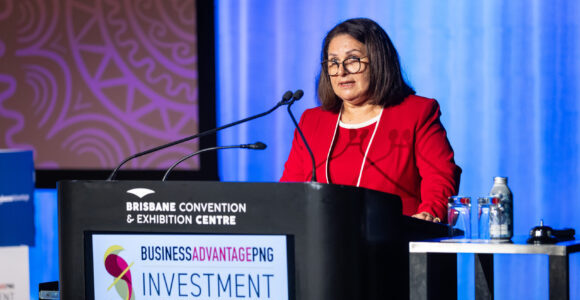
Elizabeth Genia, Governor of the Bank of PNG, speaking at the 2026 PNG Investment Conference. Credit: Stefan Daniljchenko/BAI
Papua New Guinea’s financial system is undergoing an important period of transition during which we are continuing with exchange-rate reform and the restoration of full Kina convertibility, strengthening the monetary policy framework and widening access to financial services.
These are not separate agendas. They are connected by the principle that stability provides the foundation for lasting reform and broader financial inclusion.
This broader reform agenda is particularly relevant as Papua New Guinea, together with our Pacific Island partners, prepares to co-host the Alliance for Financial Inclusion Global Policy Forum in Port Moresby from 1–4 September.
Under the theme ‘Building Resilient Economies for an Inclusive Future’, the Forum will bring central bank governors, policymakers and thought leaders from around the world to Papua New Guinea to consider how access to financial services can be broadened and how the financial system can support greater participation in economic activity.
“Financial-sector reform is not a single switch that can simply be turned on and off.”
Stability comes first
Price stability is the Bank of Papua New Guinea’s primary statutory objective while financial stability is one of the Bank’s secondary objectives. Together, they provide a more predictable environment for businesses and households to make investment and spending decisions.
The current alignment of headline and underlying inflation forecasts gives us greater confidence in the inflation outlook, but we can never be complacent. The El Niño weather pattern is re-emerging and is already affecting mining operations and some domestic food production. The Bank is monitoring these developments closely.
Financial stability requires institutions that are well regulated and able to operate through periods of economic and financial stress, supported by legislation and contingency arrangements that evolve alongside the financial system.
Earlier this year, the Bank’s Board approved an Emergency Liquidity Assistance Policy, strengthening our ability to provide temporary liquidity support to an otherwise solvent and viable commercial bank facing short-term liquidity pressures and helping to maintain confidence in the financial system.
Stability must also support participation
Financial inclusion has been a long-standing priority for the Bank, advanced through the National Financial Inclusion Strategy 2023–2027 and the Centre for Excellence in Financial Inclusion (CEFI).
The Strategy is focused on broadening access to mobile and digital banking platforms, particularly for women and rural communities, and financial literacy is also an important part of that work. Financial inclusion is about bringing more people into the formal financial system and enabling them to participate more fully in economic life.
Hosting the AFI Global Policy Forum provides an opportunity to strengthen cooperation with our Pacific Island partners and bring international attention to the progress being made in financial inclusion and the opportunities that will shape our future.
Reform is the next part of the same journey
Two important reforms are the continuing adjustment of the exchange rate and the restoration of full Kina convertibility, together with strengthening monetary-policy transmission so that the Kina Facility Rate (KFR) can more effectively influence market interest rates.
The Kina is approximately 20 per cent lower than it was in January 2023. The adjustment has been measured and gradual with minimal impact on inflation and broader macroeconomic stability.
As the exchange rate adjusted and foreign-exchange inflows strengthened, the backlog of outstanding forex orders fell significantly. While we are not yet at full Kina convertibility, we are moving in the right direction.
If we have more of the exchange-rate adjustment behind us than ahead of us, this would support moving the nominal anchor for inflation from the exchange rate back to the KFR. The KFR needs to become more effective in influencing the deposit and lending rates available to businesses and households.
This requires greater competition in the banking sector, a more active interbank market where banks lend to and borrow from each other, and an effective interest-rate corridor with a well-defined floor and ceiling aligned with the KFR and designed to support transmission of the policy rate to short-term market rates and through to interest rates in the real economy.
Other reforms matter too, including Papua New Guinea’s response to our placement on the FATF grey list, which forms part of an important national reform program.
Financial-sector reform is not a single switch that can simply be turned on and off, it is a sequence of measures that rely on a stable foundation and take time to take effect.
The AFI Global Policy Forum’s focus on building resilient economies for an inclusive future reinforces the link between financial inclusion and a stable and effective financial system.
Our aim is to support greater inclusion through a financial system that gives more Papua New Guineans the opportunity to participate in the country’s economic development.
Elizabeth Genia is Governor of the Bank of Papua New Guinea. This article draws on themes from her address to the 2026 Business Advantage PNG Investment Conference in Brisbane on 10 August. The full speech can be found here .