How Starlink and other LEO services can help unlock Papua New Guinea’s economic potential
With the recent overturning of the National Court ban on Starlink operating in Papua New Guinea paving the way for NICTA approval, James Inglis, founder of NiuPay, shares how Low Earth Orbit connectivity can transform education, save lives and boost economic participation across the country.
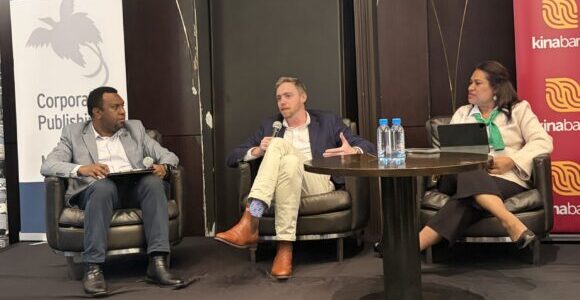
James Inglis (centre) speaking at the Innovation PNG Techbrek, hosted by POMCCI and Business Advantage International, earlier this month. Credit: BAI
Papua New Guinea’s geography has always made it challenging to develop infrastructure. As PNG’s mobile network operators can attest, delivering connectivity across vast distances and mountainous terrain requires substantial resources and limits their reach. For years, this has acted as a brake on digital inclusion and economic participation.
The arrival of Low Earth Orbit connectivity changes the equation, and I have to admit that I celebrated when the news came through on 24 April that the National Court had overturned its ban on Starlink operating in PNG. The court’s ruling – and the subsequent decision by NICTA to approve Starlink for use – is a no-brainer for PNG.
“As the founder of a PNG startup, I can attest that getting the right skills is a massive challenge. This problem does not begin in the universities; it begins in the schools.”
Starlink is the biggest LEO provider on the planet, representing around 90 per cent of all satellites in orbit right now, but it is just the first of many that could arrive in PNG in the years to come. Amazon Leo began deploying satellites in 2025 and is already the third-largest constellation in orbit, behind Starlink and OneWeb. China’s state-backed constellations Xingwang and Qianfan are also planning to compete with Starlink, and there is even talk of a Russian constellation joining them in orbit.
Progress is going to happen one way or another. So why not just embrace it?
Boost for education
One area where LEO connectivity will have a particularly meaningful impact in PNG is education.
There are approximately 14,000 schools across the country – the vast majority of them in rural or remote locations, far from physical connectivity infrastructure.
Thanks to Starlink, we now have a technology that can be deployed instantly into these remote communities, enabling schools to get connected to the internet. As the founder of a PNG startup, I can attest that getting the right skills is a massive challenge. This problem does not begin in the universities; it begins in the schools.
Therefore, connecting rural schools becomes an economic imperative. Not only does it give students access to digital tools and online learning resources. It also brings the digital world to teachers who might otherwise have to walk for days to access the internet.
There are legitimate concerns around online safety and cybersecurity that deserve discussion, but I don’t believe that these justify delaying the introduction of LEO technology into communities.
Enabling participation across the economy
In summary, the advent of Starlink and LEO technology has the ability to change a country overnight.
I was talking to someone recently who told me that with Starlink, the time to call in a Medevac and repatriate someone from a remote area has gone down from 24 hours to 40 minutes. That’s a person’s life that can be saved, and all for around 190 kina per month.
It is true that there are questions around the fact that Starlink is an international company, but we have local resellers – and I expect that the local telcos will soon join their ranks.
All in all, this technology can provide an incredible uplift to Papua New Guinea’s connectivity infrastructure capabilities – and it won’t cost the government even one toea to implement.
James Inglis is founder of NiuPay, a Port Moresby firm which partners with public sector organisations in PNG and across the South Pacific to solve tough problems with high-impact digital solutions. This is an edited excerpt of a presentation he gave on 6 May at the Innovation PNG TechBrek, hosted by Business Advantage International and the Port Moresby Chamber of Commerce & Industry.