PNG’s superannuation market is not like Australia’s – and that matters for policy
Should Papua New Guinea’s superannuation system be more like Australia’s? Lachlan Baird, CEO of PNG’s Nambawan Super, argues that such comparisons can be misleading – and he shares why he believes the focus should be on letting PNG’s super funds grow in a way that reflects the unique environment in which they operate.
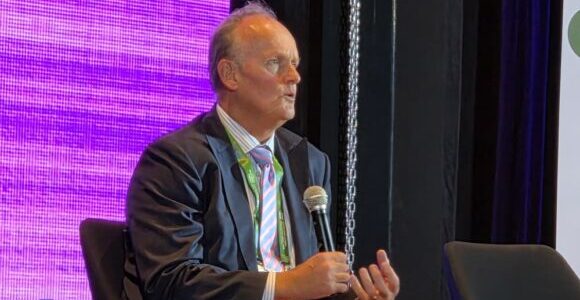
Nambawan Super Limited CEO Lachlan Baird speaking at a recent conference in Port Moresby. Credit: Nambawan Super
Comparisons between Papua New Guinea’s superannuation industry and its Australian equivalent have begun surfacing recently in policy discussions. While there is value in looking at other countries, PNG is unique – and applying a foreign framework risks setting back an industry that is still in its early growth phase.
Firstly, there is the issue of the relative size of the two markets.
The Australian superannuation industry is one of the world’s largest pension systems, with around A$4.5 trillion (K14 trillion) in funds under management – close to twice that country’s GDP.
By contrast, Papua New Guinea’s super funds manage a combined K24 billion – around one-sixth of GDP. Notably, PNG’s entire superannuation pool is one-quarter of the minimum size for a single super fund to be considered competitive by the Australian regulator, APRA.
“New entrants will come into the market as opportunities arise and when it is economically viable, not when legislation forces it.”
Secondly, PNG’s super funds operate under constraints that their Australian counterparts do not share:
- we must allow short-term withdrawals to accommodate housing advances and unemployment benefits;
- our local equity market has just 12 stocks, is relatively illiquid, and is dominated by a single bank in BSP;
- there is no secondary market for government bonds – everything is “buy and hold”;
- the PNG kina is not as liquid as the Australian dollar and is being managed as a depreciating currency until it reaches fair value;
- the local property market is tightly held, with few transactions; and
- regulations require that at least 65 per cent of all super fund assets be held domestically.
Despite all these challenges, PNG has a growing superannuation system that provides retirement benefits for around one million of its citizens.
Competition must happen organically
Those arguing that artificially creating competition – by, for example, breaking up PNG’s larger funds into several smaller ones – would bring PNG’s costs in line with Australia may be surprised by the data.
AustralianSuper – Australia’s largest super fund and the 17th largest pension fund in the world – spends A$179 (roughly K550) per member per year on administration. Nambawan Super’s administration costs last year were more or less the same: K556 per member.
Currently, the total administration fees paid across the entire PNG super industry amount to less than K30 million. If PNG’s four existing super funds were to be broken up into 10 smaller funds, this would require 10 chief executive officers, 10 chief investment officers and 10 sets of administration infrastructure. Total costs across the system would rise, not fall – and those costs would be borne by the members.
Competition will develop naturally in PNG as the market grows. New entrants will come into the market as opportunities arise and when it is economically viable, not when legislation forces it.
Lowering the domestic asset requirement
As PNG’s super industry grows, the 65 per cent minimum domestic asset requirement will become increasingly problematic.
Nambawan Super’s 20-year annual return rate to its members is approximately 9 per cent. For a fund of K13 billion, this translates to K1.17 billion in new capital that needs to be invested annually – at least K760 million of which must then stay in PNG under the legislative requirements.
For the four super funds as a whole, the domestic investment requirements now exceed K1.3 billion per year.
A small, developing economy such as PNG’s will struggle to absorb that much new investment directly from its super funds. With too much capital chasing too few opportunities, the actual outcome will be increased competition among funds for limited assets, leading to inflated asset prices and a fall in the percentage returns for members of all funds.
Moreover, if the super funds continue to grow without a decrease in the domestic asset requirement, there is a serious risk of crowding out other investors.
Building a real capital market
Real competition in an economy comes from having better, more-efficient businesses creating better products and services – not from multiplying the number of institutional investors chasing the same limited pool of assets.
Having more super funds does not, in itself, improve competition.
However, what PNG’s super funds can do is help build the conditions for genuine competition to emerge. For example, a stronger domestic listed market – one where entrepreneurs can raise capital by listing on the local exchange, where institutional investors can then buy in – would create real economic dynamism.
But that requires more Papua New Guineans to have the wealth to invest directly in locally listed companies. Growing the super pool, and widening participation in it, is the foundation for that.
PNG’s superannuation industry is young, growing and – given the environment it operates in – performing very well. Rather than pushing solutions from abroad, the policy conversation should focus on how to grow our domestic superannuation market and empower funds to keep contributing to the development of a thriving economy.
Lachlan Baird is CEO of Nambawan Super, Papua New Guinea’s largest superannuation fund.