The 2026 Fiji 100 CEO Survey
How confident are Fijian business leaders about the next 12 months? This year, for the first time, we have surveyed the CEOs of Fiji’s leading businesses to find out.

Business Advantage International’s Publishing Director Andrew Wilkins and His Excellency Ajay Amrit, High Commissioner for Fiji to Australia launching this year’s edition of Business Advantage Fiji, which includes the inaugural Fiji 100 CEO Survey. Credit: Stefan Daniljchenko/BAI
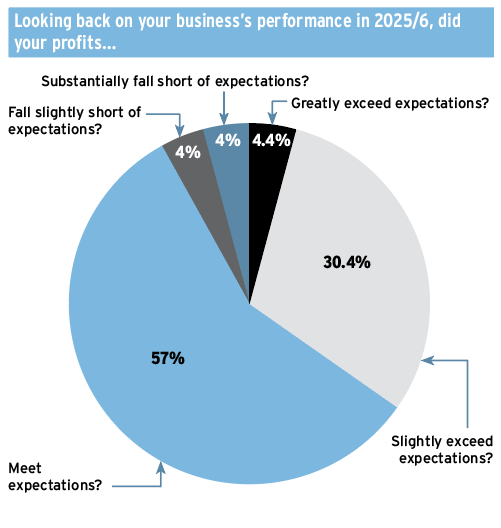
The inaugural Fiji 100 CEO Survey asked CEOs how their profits performed in 2025/6 compared to their expectations.
Businesses performed solidly, with 35 per cent of chief executives reporting that their profits exceeded expectations and a further 57 per cent saying they met expectations. Less than nine per cent of CEOs said profits fell short of expectations.
Most CEOs expressed optimism, with 57 per cent expecting profits to exceed 2025/6.
Future profit expectations
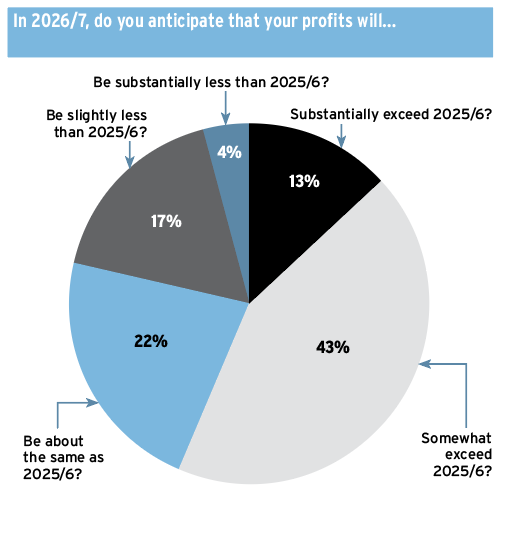
The survey asked how profits are likely to perform in 2026/7, compared to 2025/6.
Most CEOs expressed optimism, with 57 per cent expecting profits to exceed 2025/6, and an additional 22 per cent expecting profits to be about the same in 2026/7. Just 21 per cent of CEOs expected profits to be lower in 2026/7.
Investment intentions
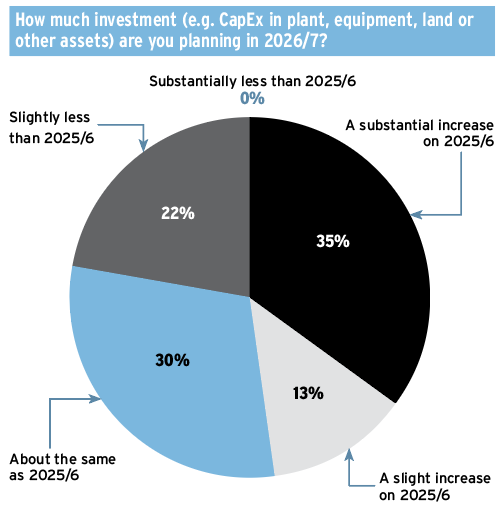
The survey asked respondents for their capital expenditure plans in 2026/7.
In a positive signal, 48 per cent of CEOs forecast an increase in CapEx, with the largest single group (35 per cent) forecasting a “substantial” increase. A further 30 per cent said CapEx would be around the same as in 2025/6, while 22 per cent flagged lower CapEx.
Recruitment intentions
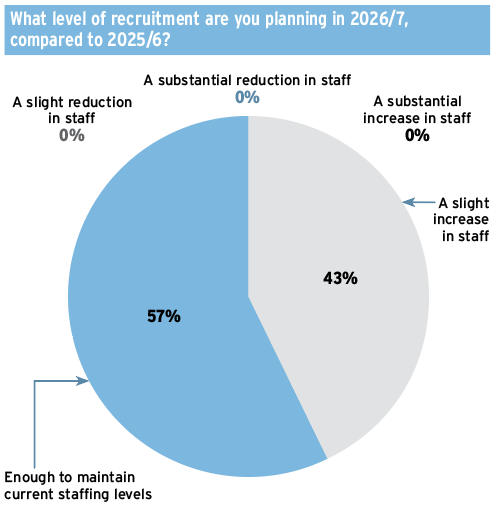
The survey asked respondents to indicate their recruitment intentions for 2026/7, compared to 2025/6.
The responses were positive overall, with 43 per cent of CEOs expecting to increase their head count and 57 per cent saying they would maintain current staffing levels. None of the CEOs said they would reduce head count.
Business impediments
We asked CEOs to rank the key impediments facing their business, from 5 for “mission critical” to 1 for “not relevant.”
Fuel price and availability emerged as the leading impediment facing Fiji businesses, with an average score of 3.70. Most responses were collected in April and May, so this score may shift as global fuel markets and geopolitics evolve. Even so, fuel topping the list underlines Fiji’s vulnerability as a remote island economy to global supply chain disruptions.
Next on the list were a shortage of expertise/skills and excessive red tape (both 3.52), inflation (3.30) and lack of market research/intelligence (3.26). At the other end of the scale, CEOs were least concerned about lack of available land (1.52), work permits and visas (1.74) and corruption (1.78).
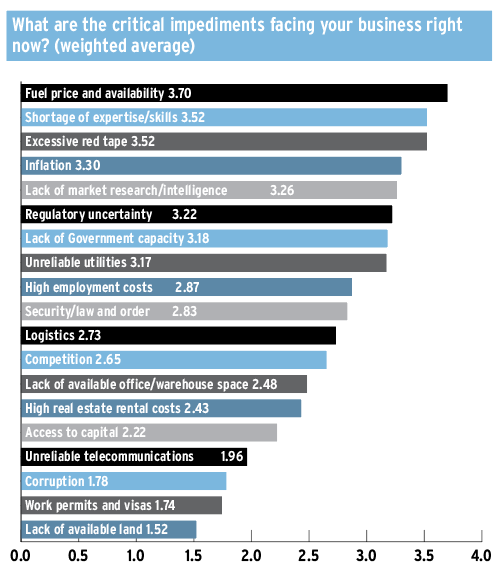
The average score across the 19 impediments was 2.74, lower than the equivalent figure of 2.92 recorded in the 2026 PNG 100 CEO Survey, suggesting Fiji’s CEOs feel somewhat less constrained overall than their counterparts in Papua New Guinea.
Fiji’s CEOs were considerably less concerned than PNG’s CEOs about corruption (Fiji 1.78 vs PNG 3.15), security/law and order (2.83 vs 4.04), unreliable telecommunications (1.96 vs 3.06) and unreliable utilities (3.17 vs 4.17). CEOs of Fijian businesses were, however, at least as concerned as those in PNG about a lack of available office/warehouse space (2.48 vs 1.91) and access to market research and intelligence (3.26 vs 3.17).
The 2026 Fiji 100 CEO Survey was conducted by Business Advantage International between April and June 2026. The survey included senior executives from a representative sample of Fiji’s largest companies, across all sectors of the economy.
This article appears in the 2026/27 edition of Business Advantage Fiji published in August 2026. Read the full edition here.