
How could Papua New Guinea finance more of its own mineral exploration?
Papua New Guinea has world-class geological potential and has operated a stock exchange for more than 25 years. Yet few mineral exploration companies are listed domestically. David Lawrence, Chairman of national stock exchange PNGX, outlines what could be done to encourage them to raise more of their finance locally.
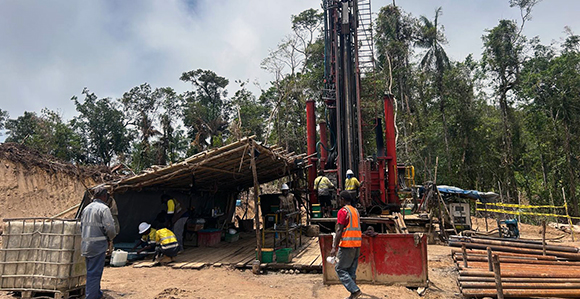
Toronto-listed explorer Adyton Resources, which is exploring for gold in Milne Bay and New Ireland provinces, commenced trading on the PNGX on 23 September. Credit: Adyton Resources
It is tempting to assume that rich mineral endowment, combined with a stock exchange, will naturally produce listed exploration companies. International experience shows otherwise.
Successful jurisdictions connect geological opportunity with capital through a combination of
- accessible geoscience,
- secure tenure of exploration leases,
- clear regulation,
- specialist advisers, brokers and analysts,
- institutional and retail investors,
- supportive tax settings,
- liquidity and,
- a market culture that recognises exploration as a legitimate high-risk, high-reward asset class.
Canada offers the clearest example. The Toronto Stock Exchange and TSX Venture Exchange together support well over 1,000 mining and exploration companies. The Australian Securities Exchange (ASX) similarly hosts hundreds of explorers and resources is one of its largest sectors.
Their advantage is not geology alone – both countries have developed sophisticated public markets designed to finance exploration.
Domestic risk capital in PNG remains limited. Institutional portfolios have traditionally favoured established dividend-paying companies and infrastructure investment over speculative exploration.
“Junior” explorers are central to this model. They acquire prospective ground, interpret geological information, raise equity, drill, define resources and either advance projects or transfer them to larger miners.
A stock exchange converts their geological concepts into funded programs, allowing a company with an exploration licence, credible data and an experienced team to raise risk capital repeatedly as the uncertainty around their project reduces.
The situation in PNG

PNGX’s David Lawrence
PNG already has important foundations. PNGX’s mining and exploration listing rules are substantially based on Australian and Canadian best practice.
As TSX Venture-listed Adyton Resources has done recently, overseas-listed explorers can dual list on PNGX while retaining home-market access. This allows Papua New Guineans to invest in in-country projects and strengthens each company’s social licence to operate.
However, domestic risk capital in PNG remains limited. Institutional portfolios have traditionally favoured established dividend-paying companies and infrastructure investment over speculative exploration. Retail equity participation is modest; specialist mining research, liquidity and deal flow are limited; and fewer brokers, analysts, geologists, corporate advisers and promoters make their business identifying and financing juniors.
These constraints reinforce each other. Explorers hesitate to list without specialist investors; investors hesitate to specialise without listed explorers; and intermediaries have little incentive to build capability without transactions.
PNG projects consequently often seek finance offshore – a pattern familiar across resource-rich developing economies such as Ghana, Tanzania, Namibia, Botswana and Cote d’Ivoire.
Three mutually reinforcing priorities
The strategic question therefore is: what conditions will produce more listed explorers in PNG?
There is no single reform that will dramatically increase exploration investment. Leading jurisdictions perform well across three connected domains: technology, regulation and finance.
First, PNG should establish a modern, publicly accessible national geoscience and exploration data platform. Exploration capital is globally mobile, and companies compare jurisdictions on both prospectivity and the quality and accessibility of information. Canada and Australia have invested in integrated digital systems covering geological mapping, geophysics, geochemistry, historical drilling and satellite imagery. Better digitisation, integration and access in PNG would reduce evaluation costs and allow more companies to assess opportunities. Data cannot create deposits, but it can create confidence – and confidence attracts capital.
Second, investors need long-term certainty of tenure and project progression. Investors accept geological risk, commodity volatility and operational difficulty; they are far less willing to accept uncertainty about legal rights following a discovery. Transparent licence administration, predictable renewals, objective decisions and a dependable path from exploration to production reduce sovereign risk.
Third, public equity markets must be developed as the primary engine of financing minerals exploration. Commercial banks rarely fund juniors that have no operating revenue, few tangible assets and prolonged negative cash flow. Exploration instead depends on successive equity raisings. Public markets are suited to that task because they distribute risk among many investors, provide liquidity and permit further capital raising as projects mature.
If these elements develop together, PNG can attract substantially more exploration investment, and PNGX can evolve from a venue that trades established mining companies into an important source of exploration capital for Papua New Guinea.
David Lawrence is Chairman of PNGX Group, owner of Papua New Guinea’s national stock exchange.