Junior miners ride the gold and copper rally into Papua New Guinea
PNG’s mineral exploration sector has rarely looked busier. Business Advantage PNG speaks with the juniors leading the charge to find out what’s behind the increase in exploration activity – and the prospects for finding the next big mineral deposit.
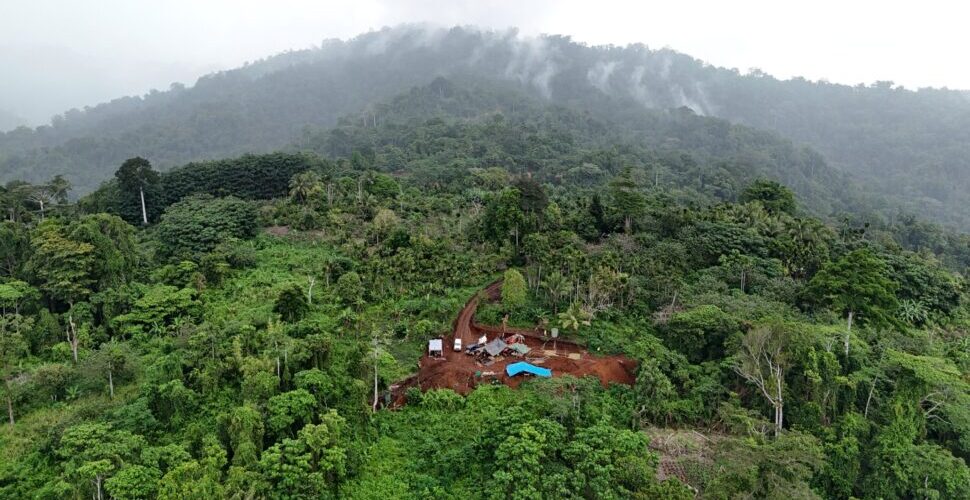
Exploration activity is continuing at pace at the Wild Dog project in East New Britain, including at the Kasie Ridge target. Credit: Great Pacific Gold
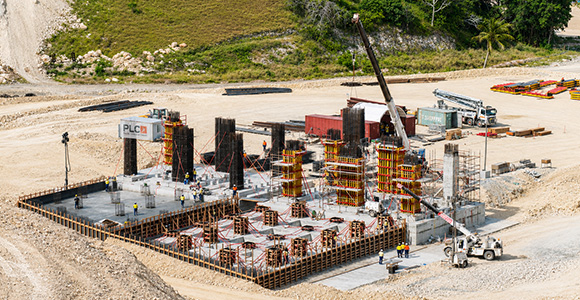
Just one year ago, Great Pacific Gold’s Wild Dog copper-gold project in East New Britain had very limited infrastructure, no established exploration camp and difficult site access. Callum Spink, Chief Operating Officer and Vice President Exploration, says the transformation over the past year has been significant, with the company establishing a fully equipped exploration camp, improving access and mobilising two drill rigs to site as exploration activity has ramped up.
It’s the kind of transformation now playing out at numerous sites across Papua New Guinea, with gold prices holding near historic highs and a resurgent copper market giving junior explorers the capital – and the confidence – to move forward with exploration and development.
“There’ll be a bit of competition [for skilled workers], but it’s fair competition, and it’s good and healthy”
On Fergusson Island in Milne Bay Province, Adyton Resources is preparing to restart the historical Wapolu gold mine by the end of 2026. The project has been fast-tracked by a May 2026 joint venture with East Vision International Holdings, a Singapore-based subsidiary of a Chinese mining group that will cover all of the capital costs.
“It’s funded, in fact most of the equipment is already on the ground in PNG, just waiting for the permits to drop,” says Adyton CEO and Managing Director Tim Crossley.
About 200 kilometres away, on Woodlark Island, Geopacific Resources is aiming to begin construction on its own gold mine in early 2027, having completed a definitive feasibility study (DFS) in May 2026.
Geopacific’s Managing Director Hamish Bohannan believes the race for skilled workers will heat up as more projects move towards development. “There’ll be a bit of competition,” he says. “But it’s fair competition, and it’s good and healthy.”
Racing to build
At Woodlark, one village is located in the footprint of one of the three planned open pits. As a result, the families have agreed to be relocated into new steel-framed homes – with 196 of the 249 homes now complete. Bohannan says PNG’s Mineral Resources Authority has been “quite impressed” with the houses, using them as a “showcard for other operations.”
Once built, the DFS projects 100,000 ounces (oz) of gold production per year across an initial 12-year mine life.
Financing the roughly A$535 million (K1.7 billion) total project cost is now Bohannan’s “absolute focus.” Geopacific is also seeking an amendment to its mining lease, which currently requires it to complete construction by October 2027 – a deadline that was set before the DFS was finalised.
“One of the attractions here is you’ve got a government that’s very supportive of mining,” Bohannan says. “It’s a country where mining is well established. We’ve got big operations here and people who understand mining.”
Adyton is moving at a similar pace on Fergusson Island – indeed, speed is the main reason it is prioritising Wapolu over its larger Gameta deposit on the same island. Wapolu produced gold under a previous owner between 1995 and 1997, before it was shut down due to the low gold prices at the time. But it has retained much of the old infrastructure, including an airstrip, port, warehouses and leach tanks.
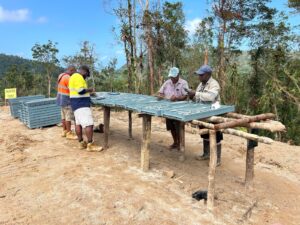
Adyton Resources’ local workforce is made up entirely of Papua New Guineans. Credit: Adyton Resources
“The elders remember what it was like and the benefits it brought to the community,” Crossley says.
Crossley argues that the island location allows development to move more quickly and less expensively than on the mainland, with supplies arriving by barge rather than road.
Wapolu’s initial production will be modest – at roughly 12,500 oz of gold per year – with the potential “to double” that figure through exploration drilling.
Gameta is the bigger prize: a newly updated resource estimate lifted its indicated gold resource by 131 per cent to 404,000 oz. Crossley is targeting a mining lease application by the end of 2026, with production “very conceivable” by the first half of 2028.
Feni Island, in New Ireland Province, is the location of Adyton’s other exploration licence – and like Fergusson’s 40-strong workforce, the 90-strong Feni workforce is entirely Papua New Guinean, without a single expatriate on site.
“My geologists are guys who are well seasoned,” Crossley says. “They’ve worked on exploration programs all over PNG – some have been at K92, some worked for Harmony, some at Ok Tedi.”
“It’s in everybody’s best interest to see these projects move forward.”
Copper’s pull
Back on the mainland, Freeport Resources’ Yandera project in Madang Province sits within the same copper-gold belt as the Ok Tedi mine and the Wafi-Golpu project. A 2017 pre-feasibility study projected around 100,000 tonnes of copper in average annual production over a 20-year mine life. This would put Yandera’s copper production on a similar scale to the 106,000 tonnes produced at Ok Tedi in 2025.
The size of the Yandera resource, and its potential value in light of soaring copper prices, has attracted attention from the likes of PNG’s state-owned Kumul Minerals Holdings (KMHL). In January 2026, Freeport signed a non-binding memorandum of understanding with KMHL to cooperate on the advancement and strategic development of Yandera.
“It’s in everybody’s best interest to see these projects move forward,” says Freeport’s Senior Vice-President of Operations Nathan Chutas. Meanwhile, Freeport is also weighing whether to fund its own definitive feasibility study or bring in a partner to assist. “We’re in discussions with a lot of really interested parties,” Chutas says. “Copper’s a great space to be in right now.”
Not only the dedicated exploration companies are eyeing copper: for example, Pacific Lime & Cement, developer of the Central Cement & Lime project, is conducting a strategic review of its Star Mountains copper-gold project in Sandaun Province. Chief Executive Paul Mulder says historical exploration has returned “fantastic world-class intercepts” – including 596 metres at 0.61 per cent copper and 0.85 grams per tonne (g/t) of gold from just 24 metres depth. The company is now seeking a strategic partner “that’s got the ability and desire to get that asset developed in a short period of time.”
Balancing geology with investment climate
While many juniors are searching for partners to help advance their PNG projects, at least one is making an exit: Niuminco recently agreed to sell the century-old Edie Creek mine, subject to ministerial approval of the indirect mining lease transfer. Mining and processing continued to ramp up at time of writing as part of a restart of the mine, under a contract mining arrangement between Niuminco and the purchasers.
Niuminco Managing Director Tracey Lake cites the current operating environment as a factor behind his firm’s divestment. “There seems to be more landowner activism going on, and that doesn’t encourage people to invest,” he says.
While Niuminco has turned its attention to its assets in New Zealand and Australia, Lake says the company isn’t pulling out of PNG entirely: in fact, it is in discussions to acquire a new prospect in the Highlands.
What keeps drawing Lake back to PNG is the price of gold – and the geology. “I still believe there’s a lot more to be found,” he says.
The exploration team at Wild Dog – which includes 14 Papua New Guinean geologists, in addition to Spink and two Australia-based senior geologists – is similarly bullish about the potential for big discoveries.
“We’re not expat heavy,” Spink says, adding, “You’ve got this amazing talent pool of geologists from across the country who have been trained by the majors and know how to run drill programs.”
Every hole drilled during a recent campaign at the main Sinivit deposit – which previously produced gold between 2008 and 2013 – intersected mineralisation, Spink says. The standout result to date was 8.4 metres at 50.1 g/t gold equivalent. Elsewhere in the licence area, the company is advancing targets including Kasie Ridge, where the first drill hole intersected an advanced argillic alteration system, a geological setting Spink says is commonly associated with the large epithermal and porphyry systems for which PNG is well known.
“We’re seeing alteration minerals and geological features that suggest we may be close to a significant mineralised system,” he says. “The work currently being undertaken by university researchers across Australia will help us better understand what that system represents.”
This article was first published in the 2026/27 edition of Mining and Energy published in October 2026. Read the full edition here.