Kumul Minerals MD on expansion plans
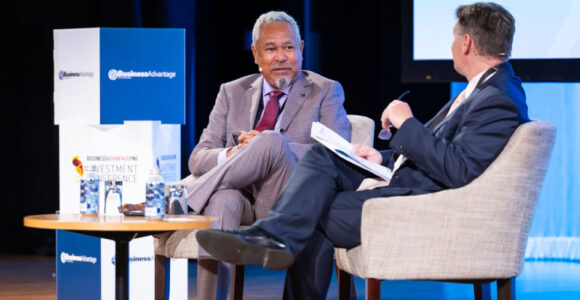
Sarimu Kanu, Managing Director of Kumul Minerals Holdings (KMHL), sits down for an exclusive interview with Andrew Wilkins, in which he discusses Porgera, Ok Tedi and KMHL’s plans around acquisitions, stranded resources and the building of a gold refinery in PNG.

Kumul Minerals’ Sarimu Kanu. Credit: BAI/Stefan Daniljchenko
Q
BAPNG: Ok Tedi has been a cornerstone of KMHL’s portfolio. How is it performing today?
A
Sarimu Kanu (SK): Ok Tedi is doing exceptionally well. In the first quarter of this year, we declared K100 million in dividends, and in the second quarter K200 million. We will surpass last year’s guidance significantly in terms of dividend payments, profit delivery and operational excellence.
As a board, we made the decision to extend mine life from 2033 to 2050 and beyond. By extending the life of mine, we will deliver up to K30 billion in additional social benefits and allow time for sustainable projects to take root.
We are also investing in new technology – moving towards fossil fuel-free mining equipment, reducing Ok Tedi’s carbon footprint and exploring into deep-seated deposits. From current drilling, the results are exceptional. We are very excited about the future of Ok Tedi going deeper.
“We have moved a long way in the mergers and acquisitions space. It’s about diversification of our revenue base.”
Q
BAPNG: And what about Porgera? How has the 2023/24 restart progressed?
A
SK: Porgera is one of the most challenging mines in the world. We have a law-and-order situation, tribal fighting, landslips and up to 2,000 illegal miners coming in droves every day.
How is it going? Exceptionally well! In the first half of 2025 alone, we [New Porgera Limited] declared US$230 million [K955 million] in dividends and paid K460 million in corporate income tax. We are bringing in a lot more forex than what was negotiated [in the agreement that led to the mine’s restart in 2023].
Trust has been built. Barrick Gold trusts us as a partner. We cannot do without the expertise and the management that they bring.
For all the challenges, we are still hitting production targets. This year, production will be around 400,000 ounces of gold, and next year it will reach 600,000 to 700,000 ounces.
Q
BAPNG: Turning to Newmont Mining and Harmony Gold’s Wafi-Golpu copper/gold project, what’s the status of negotiations?
A
SK: We are concluding the mine development contract; once we have this signed, the special mining lease [SML] will be issued.
I think we have overcome the main sticking points. Now it’s a case of don’t over-lawyer things, let’s push the petty things out of the way and get this over the line.
The next stage will be detailed engineering and design. The cost profile has changed since the original costings were done in the SML application in 2018. That will carry on for a period of time, and a final investment decision will probably come in the second half of 2027 to mid-2028.
“Our strategy is to look at stranded prospects around the country that have been drilled to a level of confidence that we can start feasibility studies on and bring to development.”
Q
BAPNG: You’ve also been active on your Milne Bay Province consolidation strategy, as demonstrated by Ok Tedi Mining Ltd’s acquisition of the Misima gold-silver project...
A
SK: Our strategy is to look at stranded prospects around the country that have been drilled to a level of confidence that we can start feasibility studies on and bring to development.
Our consolidation strategy has started in Milne Bay because there are a lot of prospects there. If you consider that Porgera will [potentially] produce 750,000 ounces of gold, if we consolidate all the prospects in Milne Bay – these could potentially match Porgera’s production.
Kumul Minerals drove the Misima acquisition. If we can build a central processing plant there that’s big enough to mine the other prospects [in Milne Bay] and feed into the plant, then we will economise them. We think that’s the best way to develop these stranded projects.
Some are high grade – we are looking at a six grams-per-tonne prospect on one of the islands – but they are small. You cannot develop them on their own.
The other thing we talk about in our consolidation strategy is shared-use infrastructure. When we build a wharf or supply ourselves with power, it must be accessible to the community. That’s why we call them projects of national importance: we are not just trying to maximise profits, we are trying to give back to the community.
Q
BAPNG: How does that feed into KMHL’s broader acquisition strategy?
A
SK: Since last year, we have moved a long way in the mergers and acquisitions space. One which has already been announced publicly [in a December 2024 memorandum of understanding with mine owner St Barbara] is our acquisition of 20 per cent of the Simberi gold mine.
We are well advanced in other discussions with operating mines. We are being very aggressive on that front. It’s about diversification of our revenue base. We are earning significantly from Ok Tedi, we want other sources of revenue. By the end of this year, we will announce major acquisitions.
Q
BAPNG: Finally, what progress is being made on plans for downstream processing in PNG?
A
SK: We are nearing completion of the definitive feasibility study on the gold refinery. The refinery will be 100 per cent owned by the state and KMHL can finance it. It will be located at Port Moresby’s Jacksons International Airport.
We have a lot of illegalities in the alluvial sector. We want to feed those into the gold refinery, as well as all our gold prospects going in – like Misima – and any other projects where we partner with big players. We are aggressively trying to complete this one and get to the groundbreaking ceremony.
In terms of nickel, MCC [Metallurgical Corp of China, majority owner of the Ramu nickel-cobalt mine] has announced that it is building a nickel smelter-refinery. This will be jointly owned by MCC and Kumul Minerals, and will be based at Basamuk, where the [Ramu] processing plant is. The good thing about MCC, being one of China’s biggest mining and manufacturing companies, is that financing is easily accessible.
We have completed the prefeasibility study. After the gold refinery, the nickel smelter-refinery will be the next big news for PNG.
This article was first published in our new Mining and Energy 2025/26 edition. Read the full edition here.