Papua New Guinea’s PM and business leaders chart next growth phase
Prime Minister James Marape and leading financiers and investors were among the key decision-makers setting out their visions for the Papua New Guinea economy at the 2026 Business Advantage PNG Investment Conference in Brisbane on 10–11 August. Business Advantage PNG reports.
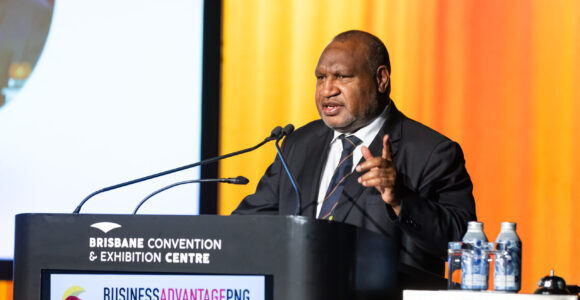
Prime Minister James Marape speaking at the 2026 PNG Investment Conference. Credit: Stefan Daniljchenko/BAI
A final investment decision (FID) on the US$14 billion-plus Papua LNG gas project “will be announced in November this year,” Prime Minister James Marape declared in his opening address to the 2026 Business Advantage PNG Investment Conference in Brisbane on 10 August. The PM’s comments set the tone for two days of discussion on a range of important business and investment topics, including how PNG can turn its potential new resources boom into lasting economic development.
Marape said he also expects a project agreement with the Wafi-Golpu copper-gold joint venture and an FID on the Pasca A offshore gas project to be completed ahead of PNG’s next National General Election, due in mid-2027.
Together with Papua LNG and ExxonMobil’s P’nyang gas project, these resources projects could account for a combined 25–37 per cent of PNG’s gross domestic product (GDP) at their peak, Daniel Faunt, Group General Manager – Corporate & Institutional Banking at BSP Financial Group, told the conference.
Marape reiterated his belief that PNG will grow into a K200 billion (around US$45 billion at the current exchange rate) economy by the early 2030s. He also pledged: “If this administration is still around in 2030, and we hit a 200 billion kina economy, you have my word: I will slash corporate tax and personal income tax by 30–40 per cent.”
“Foreign direct investment provides the confidence and the frameworks for other business growth.”
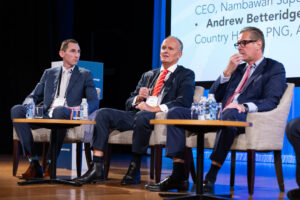
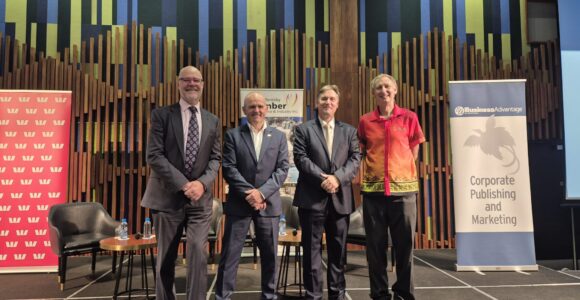
From left: Andrew Betteridge, Country Head ANZ PNG; Lachlan Baird, CEO of Nambawan Super; and Chris Daniells, Managing Director of Steamships, speaking at the 2026 Business Advantage PNG Investment Conference. Credit: Stefan Daniljchenko/BAI
Foreign direct investment the key
The Country Director for PNG at the Asian Development Bank, Takafumi Kadono, presented the bank’s latest GDP growth predictions for PNG: 3.6 per cent for 2026 and 3.4 percent for 2027.
While household consumption and agribusiness alone would help sustain such growth, Andrew Betteridge, Country Head of ANZ PNG, made the point during a moderated discussion that “it’s foreign direct investment that provides the confidence and the frameworks for other business growth.”
“Even for businesses that have no exposure to the [forthcoming] resource projects whatsoever, opportunities will come their way. That’s how we take PNG from three and four per cent growth to seven, eight [or] nine per cent growth, which is entirely realistic,” he said.
Steamships Trading Company is one business positioning for growth from resource projects. Managing Director Chris Daniells told the conference that the diversified conglomerate has poured K500 million into its maritime and logistics fleet over the past three years, “equipping PNG for the next 10 to 15 years of growth.”
“Those natural competitive advantages are your LNG and it’s your people.”
PNG’s S-curve moment?
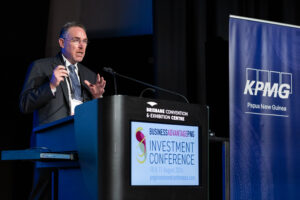
KPMG Australia Chief Economist Dr Brendan Rynne speaking at the 2026 Business Advantage PNG Investment Conference. Credit: Stefan Daniljchenko/BAI
Turning to geopolitics, KPMG Australia’s Chief Economist Dr Brendan Rynne argued that, while many economies in the Asia-Pacific region are heavily exposed to Gulf oil and fertilisers, PNG has actually seen some benefits from the closure of the Strait of Hormuz. With PNG being a net hydrocarbon exporter, Rynne noted that the PNG Government’s fuel subsidies have helped “mitigate any negative spillover into the economy” from the conflict.
Rynne also analysed a longer-term question: where is PNG’s economy headed? He presented the “S-curve” theory in which economies develop from primary industries such as mining and agriculture, through an industrial “lift-off” phase built on manufacturing, and finally into a services-driven economy. Neighbouring countries such as Indonesia and the Philippines are “relatively flat but growing” along the S-curve, he said, but PNG has gone backwards over 40 years when measuring its GDP per capita, relative to the US.
Rynne’s prescription: PNG needs a competitive energy sector and a semi-skilled workforce. “You need to target secondary industries that value-add local primary products and utilise your natural competitive advantages,” he told the conference delegates. “Those natural competitive advantages are your LNG and your people.”
What investors want
The superannuation funds, with multi-decade investment horizons, brought a similarly long-term view to the discussion.
Nambawan Super’s CEO Lachlan Baird said certainty, not just capital, is what unlocks the next stage of growth. “You need to know things are going to happen,” he said. “You need to know when you start the business that you’re going to get a return. You need to know that the law is going to remain consistent throughout.”
Locally, Baird explained, that means building the basics such as power and water before higher-value industries and services can follow. Get that right, he said, “and then we move from being just purely resources into a much broader, stronger economy.”
Eric Kramer, Nasfund’s Acting Chief Investment Officer, was blunter still. PNG has the capital and expertise, he said – so what it needs from foreign investors is partnership, not just money. “Come as a partner,” he told delegates. “We have the staying power, we have the local expertise. What we need is cooperation.”