Is Papua New Guinea’s forex market edging closer to balance?
Forex availability in Papua New Guinea has improved greatly in the past 12 to 18 months. However, whether PNG can achieve full currency convertibility will depend on a range of factors, as several of the country’s leading bankers share with Business Advantage PNG.

Foreign exchange fell from first to 12th in the rankings of business impediments in the 2026 PNG 100 CEO Survey, released by Business Advantage PNG and Westpac PNG earlier this year. Credit: MaksymKapliuk/Adobe Stock
Waiting times for forex orders currently range from “on demand to two weeks,” Rohan George, Group General Manager – Treasury and Markets at BSP Financial Group, tells Business Advantage PNG.
“That’s a substantial improvement, but having said that, it’s quite seasonal,” he said, explaining that the market tends to tighten throughout the second half of the year, before a “flood of foreign currency” typically pours in just before year’s end.
Craig Kiesanowski, Head of Financial Markets – Pacific at Westpac, says orders have been clearing within one to two weeks, and are clearing more quickly whenever one of the major resources companies pays its quarterly tax bill.
“Broadly the market is in balance, and it seems like it’s been that way for about a year,” Kiesanowski tells Business Advantage PNG, adding that now “the conversation is less about availability [of foreign currency] and more about price.” The kina has depreciated by around 25 per cent against the Australian dollar over the past 18 months, with importers passing on the higher prices to consumers, he notes.
Exports a key driver
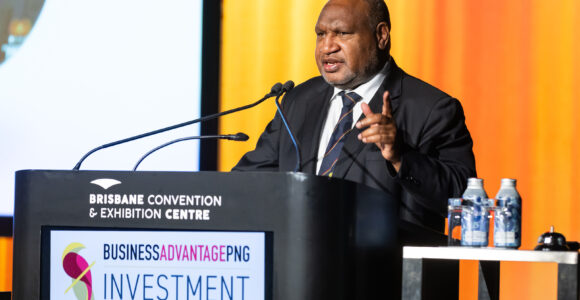
The improved availability of forex has been driven by “a surge in export receipts” on the back of higher prices of gold, LNG and agricultural commodities, Andrew Betteridge, Country Manager – PNG at ANZ Bank, commented at the recent 2026 Business Advantage PNG Investment Conference.
However, Betteridge cautions against taking the easing of forex shortages for granted, particularly if commodities prices soften.
“The key question in our view over the next 12 months is whether increasing investment flows into PNG can offset the reduction in the commodity-driven export flows to then be able to keep the market broadly in balance,” he says.
The largest investment into PNG currently being discussed is, of course, the estimated US$14.5 billion Papua LNG project, with must now reach a final decision by a ‘drop-dead’ deadline of 15 December, under its revised gas agreement.
While conventional wisdom says that substantial foreign direct investment increases the flow of foreign currency into a country, George says that Papua LNG could actually increase demand for forex before adding to supply, because of the need to pay some of its contractors in foreign currency. “That potentially could increase forex orders and create a little bit of a backlog initially in the short term,” he tells Business Advantage PNG.
George also warns of a reduction in foreign currency inflows if El Niño, the Pacific weather pattern that periodically brings drier conditions to PNG, impacts agricultural exports.
“This could drag on for longer than we saw back in 2015,” he says of the drought conditions, “so the implications could be greater.”
Bank of PNG interventions
Bank of Papua New Guinea interventions have been the other “major” factor in reducing the backlog and wait times for foreign currency, Betteridge told the conference.
The central bank’s backlog of forex orders has fallen from around K2 billion to around K200 million since it instituted a crawl-like exchange rate with the support of the International Monetary Fund in early 2024.
Elizabeth Genia, Governor of the Bank of Papua New Guinea, expressed a similar sentiment to Betteridge when she spoke at the 2026 Business Advantage PNG Investment Conference.
“As the exchange rate adjusted and foreign-exchange inflows strengthened, the backlog of outstanding forex orders fell significantly,” she said, adding, “While we are not yet at full Kina convertibility, we are moving in the right direction.”
For his part, George says that, once a balanced market is achieved, he expects the central bank and its Monetary Policy Committee to “step back to a certain extent from actively managing the kina.”
“Their way of managing the kina will be more through day-to-day or week-to-week forex intervention rather than a policy objective,” he says.