Papua New Guinea’s very own Chinatown taking shape
Lemach Lavari reports on the Chinatown development that is taking place in Port Moresby, with the first phase due to open in December.
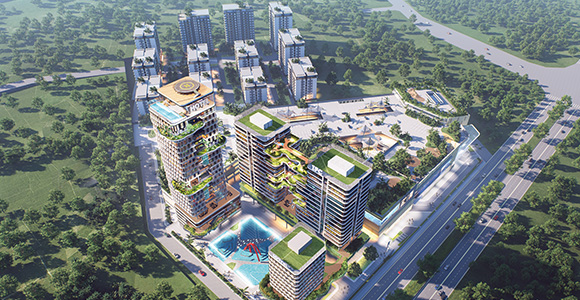
An artist’s impression of the Chinatown project. Credit: Baosen International Holdings Ltd
Port Moresby is a city in transformation. Across the capital, new roads, commercial precincts and urban developments are reshaping the skyline and redefining how the city presents itself to the world. At the centre of this transformation stands one of Papua New Guinea’s most ambitious developments to date – the Baosen Chinatown project at Five Mile.
Rising prominently along the intersection of Boroko Drive and Hubert Murray Highway, opposite the Five Mile service station, Baosen Chinatown will be more than a shopping complex. It will be a master-planned urban precinct designed to combine commerce, lifestyle, hospitality and residential living within a single destination.
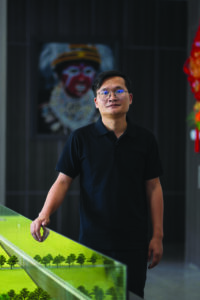
Baosen’s Marketing Director Ben Wang Huan. Credit: Norman Ketan
“The project is called Chinatown but the approach is global and aimed at building an internationally friendly community and not just Chinese as many would wrongly assume.”
Developers describe it as a “city within a city,” a vision that reflects both the scale of the project and its long-term significance for Port Moresby.
According to the developer, Baosen International Holdings Limited, the precinct will ultimately contribute towards Port Moresby’s modern outlook.
“Our aim is to provide international modern city lifestyle experiences to residents and visitors of Port Moresby, whether it be in retail brands, food or entertainment,” Baosen’s Marketing Director, Ben Wang Huan, says.
“The project is called Chinatown but the approach is global and aimed at building an internationally friendly community and not just Chinese, as many would wrongly assume.”
Located within Port Moresby’s Five Mile corridor, Baosen Chinatown is expected to become one of the most significant private-sector property developments undertaken in the Pacific region in recent years.
At about 270,000 square metres, the development is expected to become one of the largest commercial centres in PNG.
Multi-phase development
The project’s location, about five minutes from Jacksons International Airport and close to major commercial centres, positions it as a strategic gateway for business travellers and tourists.
The first phase, due to open in December, establishes the development’s commercial core with a 90,000-square-metre retail complex comprising 396 strata-titled commercial units. The precinct will feature supermarkets, specialty retail outlets, restaurants, entertainment facilities and extensive parking.
The second phase, with an expected opening in 2027, will deliver 12 residential towers containing more than 800 fully furnished apartments. Offering two- to four-bedroom units, the development will include lifestyle amenities such as swimming pools, gymnasiums, landscaped recreational areas and 24-hour security.
The final phase, with an expected opening in 2028, will expand the precinct into a major corporate and tourism destination through the construction of a five-star hotel, office towers, conference facilities and a dedicated business centre. This phase is designed to attract international visitors, investors and corporate tenants.
For visitors, Baosen Chinatown promises an experience unlike anything available in Port Moresby. Visitors will be able to explore a diverse range of retail outlets, enjoy international and Asian-inspired cuisine, and experience a lively environment that, the developers say, is designed for families, professionals and travellers alike. Entertainment facilities such as a cinema, children’s recreation areas and lifestyle amenities are expected to further strengthen its appeal.
“We welcome business owners; there are great opportunities to do business here. For families, we’re introducing a new lifestyle aligned to global urban standards,” Huan says.
Beyond tourism, the project represents a significant statement of confidence in PNG’s economic future. The development is being positioned as a major investment hub, with hundreds of commercial spaces available for businesses and entrepreneurs.
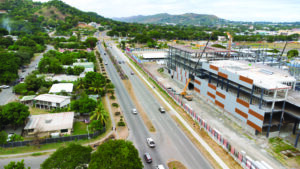
Chinatown under construction at Five Mile. Credit: Norman Ketan
Importantly, the developers say, Baosen Chinatown reflects the evolving multicultural identity of modern Port Moresby. The project seeks to create a space where cultures meet, businesses connect and communities engage. Developers have emphasised cultural integration and community-building as part of the precinct’s broader vision, highlighting the longstanding contribution of the Chinese community to commercial growth while fostering new partnerships and opportunities for Papua New Guineans.
The Governor of Port Moresby, Powes Parkop, supports the project, viewing it as a massive economic investment that will create jobs, and elevate the city’s status into a modern, global commercial and cultural hub.
The development arrives at a time when the city is increasingly embracing large-scale urban planning and modern city-building initiatives, including the arrival of several five-star hotels.
The developers say: “For tourists, it offers a fresh reason to explore Port Moresby. For investors, it signals confidence and opportunity. For residents, it represents a glimpse into a more modern urban future.”