Papua New Guinea banking enters its digital age
Papua New Guinea’s banks are scaling up digital platforms to fuel growth and advance financial inclusion, as CEOs in the sector tell Business Advantage PNG.

Kina Bank was the first commercial bank in PNG to conduct full retail
customer onboarding through its DigiBankr platform in 2023. Credit: Kina Bank
The era of digital banking has well and truly arrived in PNG, with further investment in digitalisation at the centre of virtually every bank’s growth strategy.
As Andrew Cairns, CEO of Westpac PNG, explains to Business Advantage PNG, digitalisation is not just about offering Papua New Guineans another way to bank, but also about shaping how they engage with the financial system.
“Giving customers access to their account without having to take cash or foreign currency has been a big winner for us.”
“It [digitalisation] gives us the ability to be able to address some of the issues associated with a cash-based society … By having a safe, reliable, consistent e-banking experience, you can change people’s behaviours,” he says.
“The second thing it enables is financial inclusion. Those who are underbanked or non-banked: we have the opportunity to be able to bring them into the system and provide them with access to funds and capabilities which are safe.”
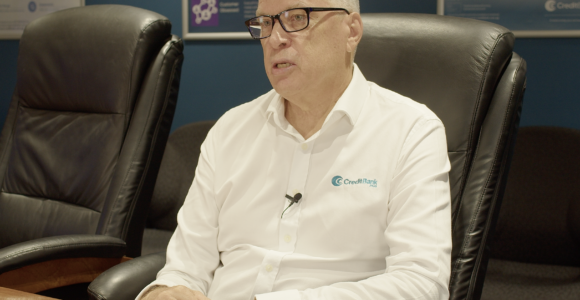
In a country with a large and widely dispersed rural population, digital banking is already transforming access. There is no better illustration than the case of CreditBank PNG, which received a full commercial banking licence in 2024.
CEO Danny Robinson tells Business Advantage PNG that its digital platform has been the key to its successful launch: “Our customers have been able to open accounts right across the country using our digital app. We’ve opened accounts in all 22 provinces.”
Digital onboarding the new norm
Digital onboarding has become the standard at CreditBank, where 70 per cent of new customers open their accounts online “without ever having to come into the branch,” according to Robinson.
It is also critical to the strategy of another new bank, TISA Bank, which is targeting the estimated 75 per cent of Papua New Guineans who are unbanked.
“We want to make it convenient, accessible and affordable,” says TISA Group CEO Michael Koisen, explaining that a bank account is not a requirement to use TISA Bank’s mobile wallet.
Digitising Know Your Customer (KYC) processes is an important part of onboarding.
Ivan Vidovich, CEO of Kina Bank, says his bank worked closely with the Bank of PNG to demonstrate that fully automated digital onboarding reduces risks compared to traditional manual processes.
“We found that the regulator was very accommodating and willing to work with us on those innovation opportunities,” he says.
Mobile options on the rise
In addition to building digital platforms, PNG’s banks are finding innovative ways to reach customers who have limited access to technology.
BSP’s USSD-enabled Wantok Wallet enables users to text instructions without a smartphone, internet access or a bank account.
Kina Bank’s WhatsApp Banking allows users to text instructions through the popular messaging platform, and in 2025 it introduced Kina Pei, allowing customers to digitise their visa debit card to tap and pay using their smartphone.
CreditBank also allows users to add a digital version of their credit card or debit card to their mobile banking app.
“Giving customers access to their account without having to take cash or foreign currency has been a big winner for us,” CreditBank’s Robinson says.
TISA Bank offers a variety of digital banking options, including a mobile app and USSD and WhatsApp banking. According to Koisen, the plan is to eventually build a “super app” that allows users to manage all their financial transactions, including paying bills.
Notably, PNG’s telcos are also actively involved in providing financial services, with Digicel’s CellMoni boasting around 1.6 million individual users, or around 53 per cent of its customer base.
Its main competitor, Vodafone PNG, is now playing catch-up. Its own digital banking product, M-PAiSA, already proven in Fiji, has also been licensed and approved for use in PNG, its Regional CEO Pradeep Lal confirms to Business Advantage PNG.
Balancing act
PNG’s digital banking journey can be traced back to 2008, when the central bank published a strategy to reduce the country’s reliance on cash “through the use of modern electronic forms of payment.”
However, it is still too early to dismiss the cash economy, according to ANZ PNG Country Head Andrew Betteridge.
“While ANZ customers are largely digital now and our ongoing investments in technology and platforms are helping to make banking more secure, there’s still a lot of cash out there,” he tells Business Advantage PNG, adding that the bank is supporting digitalisation to reduce risk and speed up payments.
National Banking Corporation’s outgoing CEO, Paul Thornton, offers a similar picture.
“Electronic banking will also be an important channel for us but we’re still of the view that you must have a physical branch presence as well,” he says.
“It’s still a cash economy; it’s going to be for the foreseeable future.”
Nevertheless, it appears investments in digitalisation will only increase in the finance sector – and not only among the licensed banks.
Moni Plus, a financial institution with ambitions to become a commercial bank, recently acquired a new core banking system, which should begin handling all back-end operations by the middle of this year.
The new technology could precede an eventual rollout of digital banking, Moni Plus CEO Aho Baliki says.
“We need to make sure that our [core] technology supports us in bringing new technologies on board, such as digital banking platforms,” he tells Business Advantage PNG, adding that any investments must serve his organisation’s eventual goal of being able to compete with the other banks.
This piece was first published in the 2026 edition of the Business Advantage PNG Annual. You can read the full issue here.