The other LEO satellite provider: Papua New Guinea business begin trials of OneWeb
While Starlink was approved for use in PNG in late April to much fanfare, the approval of another LEO service – OneWeb – has received relatively little attention. Robbie Huxley, Managing Director of TE PNG, tells Business Advantage PNG why OneWeb’s arrival is such an important moment for Papua New Guinean businesses.
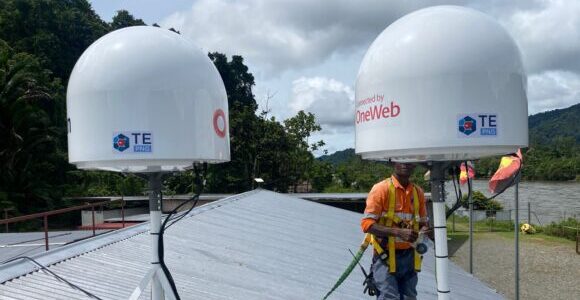
TE PNG has installed the Intellian OW70L dual antenna system for OneWeb at Frieda River. Credit: TE PNG
Low Earth Orbit (LEO) satellite provider Starlink has understandably dominated the conversation around satellite connectivity in Papua New Guinea, in part due to the lengthy National Court case that prevented an operator licence being issued to the SpaceX-owned service until 29 April this year.
By contrast, the other LEO service approved this year – OneWeb, operated by France’s Eutelsat Group – has received less attention but may prove equally significant.
“These services are coming whether we like it or not.”
Between January and February, the National Information and Communications Technology Authority (NICTA) granted test permits to four companies, including TE PNG, to supply OneWeb in Papua New Guinea.
While both services use satellites to deliver internet connectivity, the markets they are aimed at and the way their services are delivered differ markedly.
In keeping with its mass market appeal, “Starlink is a direct-to-consumer model for the most part. It can be sold by anyone,” Robbie Huxley, TE PNG’s Managing Director, explains to Business Advantage PNG.
OneWeb, on the other hand, is aimed at the enterprise market and its implementation is therefore more demanding.
“OneWeb is offered purely through a distribution channel, and therefore you can’t just go and buy it directly,” says Huxley. “You must work through an approved provider.”
First deployment
While OneWeb can be deployed anywhere, it is particularly valuable in remote, geographically challenging locations, according to Huxley.
Shortly after securing its licence, TE PNG announced the successful deployment of its OneWeb service at PanAust’s Frieda River copper-gold project, located in Sandaun and East Sepik provinces.
Communications at Frieda River have historically depended on high-frequency radio and limited satellite options, imposing “an operational constraint for safety, logistics and community engagement,” says PanAust Country Manager Joel Hamago.
Now, with the deployment of OneWeb, TE PNG has installed two parabolic-shaped antennas “that physically move, but they provide a much better receive signal and transmit capability in the weather,” Huxley says.
“We’ve been running a service in Port Moresby for a couple of months and seen fantastic results on that. But deploying it in a place like Frieda, where it’s possibly raining 12 hours a day, that’s where we’re really going to see the difference in the service quality.”
Interest from other sectors
TE PNG has also deployed OneWeb at the Tolukuma gold project in Central Province and is in talks with a number of other mining and oil and gas customers.
However, it is not only looking to the resources sector for customers, Huxley reveals.
“A number of the larger enterprise customers are looking at this. We’re in talks with the banking sector about linking up branches across multiple provinces, including remote and regional locations where dependable connectivity is critical,” Huxley says.
“A lot of these organisations are working on cloud applications such as Microsoft 365. Achieving lower latency and lower rates of jitter on applications such as Microsoft Teams has become more critical for businesses – and that’s what LEO can offer.”
‘Now is the time’
In many cases, Huxley explains, the different LEO services can complement – rather than compete – with each other.

Robbie Huxley. Credit: BAI
“You can take that lower-cost, best-effort service [such as Starlink] and use it with a higher-cost guaranteed service [such as OneWeb] and get the best of both worlds,” he says.
“You’re then running what we call multi-constellations. As we know, nothing is infallible. Even Starlink has had its global outages at times.”
Calling the approvals of both LEO services “a great step in terms of enterprise connectivity,” Huxley says that now is the time for the regulator to look at how it can work with these services “and get the best for the country and the economy as whole.”
Noting that Amazon’s LEO service, named Amazon Leo (formerly Project Kuiper) is targeting a mid-2026 commercial launch, he says “these are the sorts of conversations that need to be had now because these services are coming whether we like it or not.”