Explainer: Inside Papua New Guinea’s revised Papua LNG gas agreement
Last week’s revised gas agreement between the Papua New Guinea Government and the developers of the Papua LNG project sets a 15 December ‘drop-dead’ deadline for a final investment decision. Business Advantage PNG examines why the agreement was revised, what it means for the project’s ownership structure, and what steps remain to reach FID.
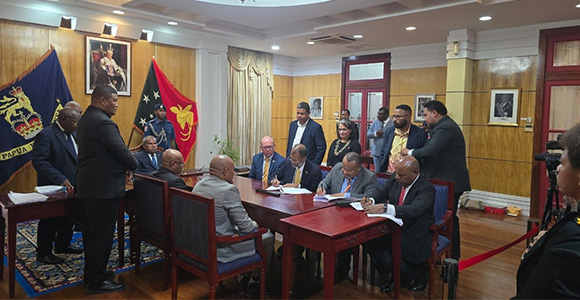
Representatives of the PNG Government and the Papua LNG project developers were present at the signing of the revised final gas agreement on 27 August. Credit: Kumul Petroleum Holdings.
Last week saw the signing of a revised final gas agreement between the PNG Government and the developers of the now-estimated US$14.5 billion Papua LNG project.
This deal amends the original gas agreement signed in 2019 between the State and TotalEnergies, ExxonMobil, Santos and ENEOS Xplora.
It offers new benefits to the developers aimed at reducing project risk, in return for additional benefits to the State and a 15 December deadline for a final investment decision.
Key takeaways
- The government and the developers of the Papua LNG project signed a revised final gas agreement on 27 August, amending the original 2019 deal.
- The agreement sets a 15 December ‘drop-dead’ deadline for a final investment decision.
- There is now a ‘very high possibility’ that ExxonMobil will take over as project operator from partner TotalEnergies.
- The State has offered the developers conditional incentives worth US$1.95 billion (K8.1 billion), triggered only if LNG prices fall below a set level after 2031/32.
- In addition, the State can now acquire up to 25 per cent in the project, compared to 22.5 per cent under the previous agreement.
Why a revised agreement?
The revised agreement follows eight months of negotiations between PNG’s State Negotiating Team and the developers, who were seeking to bring the total development cost down to between US$14 billion and US$15 billion. This follows original bids received from mostly European contractors in 2023/24 which saw the project’s cost blow out to more than US$18 billion.
While bids from Asian contractors in 2025 brought down the estimated costs, the developers still sought further concessions to improve the project economics.
With both TotalEnergies and ExxonMobil also developing substantially larger LNG projects in Mozambique, there was a risk that the smaller 5.6 Mtpa Papua LNG project might be postponed again unless the issue of costs could be addressed.
What’s been agreed?
In the words of Kumul Petroleum’s Acting Managing Director Luke Liria, “the amendments strike a balance between attracting global investment and protecting PNG’s long-term national interests.”
The State hasn’t relinquished its formal share in the project revenues. However, it has granted the developers conditional investment incentives which, according to Petroleum Minister Jimmy Maladina, are “temporary, reciprocal and appropriately capped arrangements linked to market conditions.” These incentives are worth US$1.95 billion (K8.1 billion), according to a reported statement by Prime Minister James Marape.
The revised agreement reasserts the State’s right to acquire up to 22.5 per cent of the project – comprising up to 20.5 per cent for state-owned Kumul Petroleum Holdings and two per cent for the Minerals Resources Development Company – as and when the project’s Petroleum Development Licence is issued. It also adds an option, which was not a part of the previous agreement, for KPHL to acquire an additional 2.5 per cent in the project at some stage in the future.
As Dairi Vele, Chairman of PNG’s State Negotiating Team, tells Business Advantage PNG, the incentives kick in to help the developers maintain their required internal rate of return from the project should LNG prices fall below a certain level in the future.
“We have referenced the specific price of gas post-construction, in 2031/32,” he explains. “If LNG is below that price, then PNG can give the developers some assistance. This way, they get assistance only if they need it.”
Why a 15 December deadline?
The existing five-year Petroleum Retention Licence (PRL15) over the Elk and Antelope gas fields in Gulf Province, which will supply Papua LNG, expires on 30 November this year.
Effectively, the 15 December deadline provides for a two-week extension of the lease to allow for arrangements to be finalised. The government has indicated it has little appetite to provide further extensions.
“The final deadline for FID is a drop-dead deadline,” Maladina said last week. “The Government expects all parties to work towards meeting this deadline.”
There is additional urgency for both sides, with PNG due to conduct national elections in mid-2027.
What’s still to come?
With the gas agreement amended, the next important milestone for the project is the successful completion of its Development Forum, which commenced in July and is still under way in Port Moresby. The purpose of the forum is to agree on the allocation of project benefits to landowners and local governments.
“Our understanding is it’s been progressing well … all the feedback has been very positive,” Kevin Gallagher, Managing Director and CEO of Santos, told an investor briefing on 19 August. “We’d expect to go through until the end of September, or something like that, before it concludes.”
“We’re 100 per cent confident we can deliver a successful development forum,” Vele tells Business Advantage PNG, pointing out the success of the 2009 PNG LNG development forum, which involved “75,000 people and five different provinces … [while] Papua LNG involves between 5,000 and 10,000 people.”
Meanwhile, the developers are now working to finalise marketing arrangements for the project’s gas, as well as its financing.
Change in operator?
Notably, the revised agreement doesn’t stipulate the identity of the project’s operator, although according to Vele, there is a “very high possibility” that ExxonMobil will take over as operator from TotalEnergies.
The joint venture partners are still in detailed discussions on how to best execute the project, Gallagher said at the Santos investor briefing. “Any changes or updates on how we’re going to do that, I would expect the operator to announce at the appropriate time.”