Clearing the ‘bottleneck’: NAC Chairman on the redevelopment of Jacksons International Airport
Work has begun on the first phase of a planned multi-billion-kina, four-phase redevelopment of Port Moresby’s Jacksons International Airport. Jacob Anga, Chairman of the National Airports Corporation, talks Business Advantage PNG through each stage and how they will be funded, as well as upgrades to regional airports across Papua New Guinea.
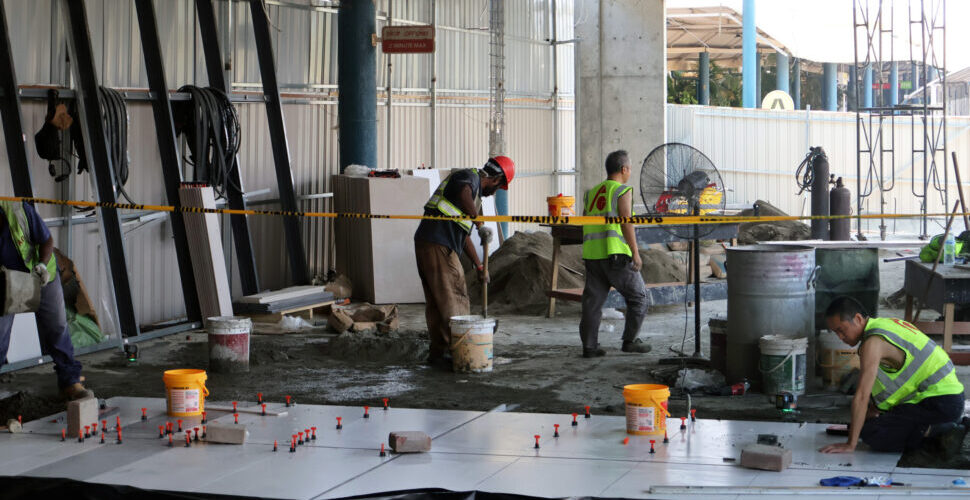
Development is well underway on the revamped domestic terminal at Jacksons Airport. Credit: National Airports Corporation
Port Moresby’s Jacksons International Airport is undergoing its biggest redevelopment in nearly 30 years, as a surge in traffic strains its domestic and international terminals.
Passenger numbers at the country’s main gateway have more than doubled since 1997 to 1.68 million in 2025, and are projected to reach 2.5 million by 2035 and 3.7 million by 2045.
The multi-billion-kina redevelopment, led by the National Airports Corporation (NAC), will be delivered in four phases ahead of Papua New Guinea’s hosting of APEC 2033. The phase-one expansion of the domestic terminal was launched in June.
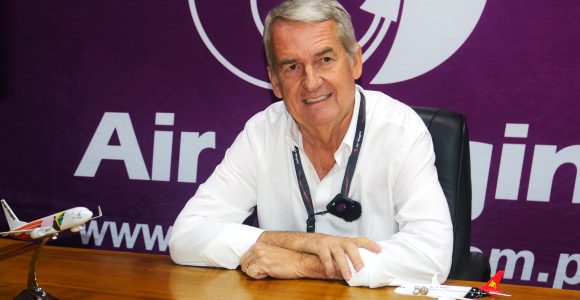
“When I took over as chair two years ago, we decided we couldn’t keep allowing the airport to be a bottleneck,” NAC Board Chairman Jacob Anga tells Business Advantage PNG.
Both terminals were designed for far fewer passengers, he explains, adding that economic growth has since fuelled a boom in domestic travel in particular. Further demand is expected as Papua LNG and P’nyang gas projects move towards final investment decisions.
Four phases
Phase one, a K24.7 million extension being built by PNG civil engineering firm AG Investments, will triple the domestic terminal’s capacity. It is due to be finished by December – a “Christmas present” for the travelling public, Anga says.
The current 1,000-person capacity means that passengers must often join the queue outside of the terminal building, he says. “Now we [will be able to] move about 3,000 people in and out, which is huge for us.”
Phase two will reconfigure the domestic terminal, adding at least 24 check-in counters, travelators and a larger upstairs departure lounge. Phase three will upgrade the area where aircraft are parked, loaded, refuelled and boarded, and will add aerobridges for Air Niugini’s new fleet of 11 Airbus A220s.
Phase four will deliver a new international terminal and lengthen the runway from 2,750 to 3,500 metres. The current international terminal will then be combined with the domestic terminal, Anga says, adding that Air Niugini could then get its own terminal, much as Qantas has at major Australian airports.
Anga also envisages the construction of a long-mooted “airport city” – a precinct of hotels, retail, banking and conference facilities on NAC land in front of the new international terminal – alongside phase four.
With short-stay travellers comprising around 60 per cent of visitors to PNG, convenience is a selling point. “We’ll try to create a terminal that’s a one-stop shop.” Anga says. “You come to our terminal, everything’s there.”
Funding model
So far, only phase one has funding committed, with K20 million from the government and K5 million from the NAC. Phases two and three are earmarked for the Asian Development Bank’s (ADB) proposed third Civil Aviation Development Investment Program (CADIP III).
Financing for phase four is yet to be arranged. It cannot be funded by government alone and will need a public-private partnership, Anga says. Ernst & Young in Sydney is building a financial model, and law firms in Australia and PNG the legal structure. Anga expects this to take about 12 months. “Once we have that, then we can go to the market and say: ‘we’ve de-risked most of the things upfront. Now it’s for you to jump on’.”
For the airport city, NAC intends to approach local investors, such as superannuation funds and state-owned enterprises, to take equity in a dedicated vehicle.
Regional reach
Beyond the capital, some runways need strengthening to handle the heavier A220s. At Mount Hagen’s Kagamuga Airport, NAC is funding a K39.4 million runway upgrade that will allow the A220s to land there from December.
Separately, the PNG government and the ADB are co-funding broader safety upgrades at five regional airports under CADIP II. For example, Alotau’s Gurney Airport (Milne Bay) completed a K76.8 million upgrade in August. At Kimbe’s Hoskins Airport (West New Britain), runway works due to finish by year-end will also allow it to take the A220.
A new terminal at Kokopo’s Tokua Airport is also being planned. “It’s a major tourism hub,” Anga says. “We will then … open it up for international flights.”
For Anga, the stakes are national: “Because of the geography of the country, we are probably the only conduit that connects the country together.”