
Closing Papua New Guinea’s skills gap
Business leaders discuss PNG’s skills shortages – and how the country can best develop its future talent as more major resource projects gather on the horizon.

While specialist skills in the resources sector have improved, there are still acute shortages in some areas, says the Business Council of PNG’s Susil Nelson-Kongoi. Credit: Dirio Power
Papua New Guinea doesn’t have a shortage of talent – what it lacks is sustained investment in that talent and “a pathway” for PNG nationals to progress their careers, according to Gregory Mataenge, Manager ICT and Cloud at Vodafone PNG.
Mataenge made the comments during a panel discussion at the 2026 Business Advantage PNG Investment Conference, in which participants discussed how the country can address skills shortages ahead of major new projects, including Papua LNG.
“We should be paying the right money for the right people to do the right job, and then empowering our people to train and teach and develop the skill sets of our people”
Susil Nelson-Kongoi, President of the Business Council of PNG, said the country is in a “considerably stronger” position than it was in 2010, when construction began on the PNG LNG project. More than 20 million hours of training were delivered across 13,000 programs during the four-year PNG LNG construction phase, she said, and the project has since employed more than 10,000 Papua New Guineans.
“Today, in the LNG sector, the operating workforce is around 91 per cent Papua New Guinean,” Nelson- Kongoi said. “It demonstrates that, when we have sustained investment in training, localisation is achievable.
“More importantly, we now have a generation of Papua New Guineans who have accumulated over a decade of experience working on LNG facilities, mining operations, petroleum fields, power generation and other major infrastructure projects.”
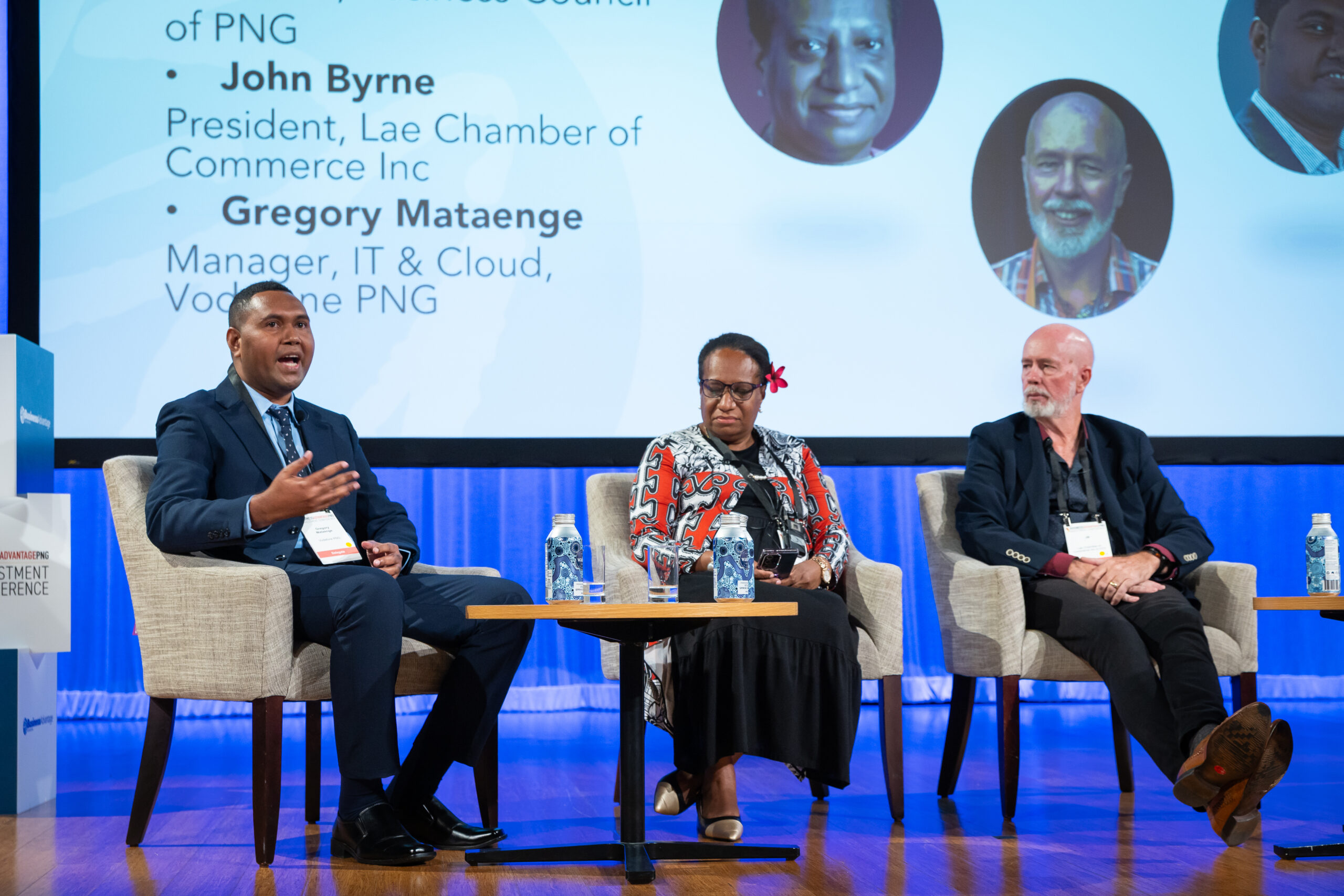
From left: Gregory Mataenge, Manager ICT and Cloud at Vodafone PNG, Susil Nelson-Kongoi, President of the Business Council of PNG, and John Byrne, President of the Lae Chamber of Commerce and Industry. The panellists discuss PNG’s skills for the future at the 2026 Business Advantage PNG Investment Conference. Credit: Stefan Daniljchenko / BAI
However, she noted that gaps remain in “specific competencies,” including those internationally recognised certifications that are required by EPC [engineering, procurement and construction] contractors. In addition, she said there are “acute” shortages in critical construction trades and in emerging technical skills such as automation, digital monitoring and process control.
Workforce development
Turning to possible solutions, Nelson- Kongoi urged the PNG Government to focus on creating the “enabling environment” for businesses to train the next generation of skilled workers.
“We need to make workforce development a national economic priority,” she said, with government “working closely with industry to identify occupations and competencies that major projects and the wider economy will require.”
She called for continued investment in PNG’s technical and vocational education and training (TVET) institutions, noting that the Australian government is already funding TVET institutions in PNG.
A sustainable financing mechanism for workforce development is also needed, Nelson-Kongoi said.
Lastly, Nelson-Kongoi said that, if projects are spending heavily to recruit and mobilise expatriate workers, “maybe we should ask how some of that investment can be redirected into national training assets like welding laboratories, simulators, instrumentation workshops, tradetesting facilities and other infrastructure that can actually develop our workforce for the future.”
Retaining talent
The Government is already ramping up investments in institutions such as the National Polytechnic Institute of PNG and Malahang Technical Secondary School in Lae, according to John Byrne, President of the Lae Chamber of Commerce and Industry. Notable also is the August 2026 opening of the PNG University of Technology’s new School of Petroleum Engineering.
Byrne warned, though, that PNG risks losing trained workers between project cycles without a steady pipeline of work to retain them.
Retention of staff, he said, ultimately comes down to reward and culture: “We should be paying the right money for the right people to do the right job, and then empowering our people to train and teach and develop the skill sets of our people.”
Vodafone’s blueprint
Outside the resources sector, Vodafone PNG offers a case study in what sustained investment in local talent could like in practice.
A subsidiary of Fiji’s Amalgamated Telecom Holdings, Vodafone launched in PNG in 2022. Its workforce now numbers 1,400 employees, Mataenge said, “and we’re particularly proud that 97 per cent of that workforce are Papua New Guineans.”
This article was first published in the 2026/27 edition of Mining and Energy published in October 2026. Read the full edition here.