Help from above: 75 years of the Mission Aviation Fellowship
Mission Aviation Fellowship has been flying in PNG for 75 years, delivering help where needed with medical supplies, emergency evacuations and more. Richard Andrews reports.
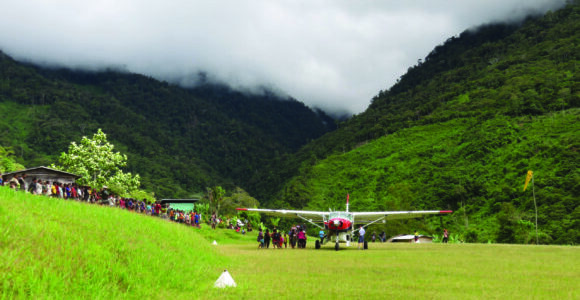
Crowds gather next to a grassy airstrip for the arrival of a Mission Aviation Fellowship
flight in Tumolbil near the Indonesian border in West Sepik. Credit: Bridget Ingham
Tropical cyclones, lifesaving flights, coffee runs, steep mountain airstrips and intractable dogs. Just another day in the office for Mission Aviation Fellowship (MAF).
In 2026, the Christian organisation looks back on 75 years of bringing “help, hope and healing” to more than 600 isolated communities across Papua New Guinea.
On May 7, 1951, Edwin ‘Harry’ Hartwig took off in an Auster Autocar on MAF’s first operational flight in the country. A former captain of a B-24 Liberator in World War 2, Hartwig dreamed of devoting his “God given aviation skills to serve people in need”.
Tragically he died about four months later, when his plane crashed in the notorious Asaroka Gap, during a return flight from the Eastern Highlands to Madang.
“Flying float planes is a special skill. Obstacles include driftwood and sandbars. Joseph (a MAF pilot) has also joked about running into crocodiles.”
Today, MAF remains committed to fulfilling Hartwig’s dream with a fleet of 11 Cessna Caravan aircraft. “Serving people in need” ranges from the transport of health workers, medical supplies and education essentials to shipments of village products and provision of ambulance services. Medivac emergencies can vary from farming accidents and difficult pregnancies to snake bites and run-ins with wild pigs
MAF humanitarian missions have also included responses to the Aitape tsunami disaster on PNG’s north coast in 1998. The same year, MAF provided relief to communities suffering severe drought, frosts and famine in both PNG and West Papua.
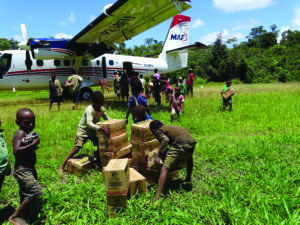
Earthquake relief at Walagu in 2019. Credit: Mathias Glass
When Cyclone Maila flooded Bougainville last April, MAF supported the delivery of emergency aid and aerial surveys, to assess the extent of damage across the island.
“Floodings in rivers washed away and buried food gardens beside rivers. These gardens are what most people have, and what they survive on,” says Reverend Abraham Toroi, Bishop Emeritus of the United Church in Bougainville.
“MAF came and flew relief, food and supplies to the central places like Kieta. From there, it was distributed to various communities or atolls.”
With a population of more than 10 million scattered across an area larger than Germany, access to transport is often a major challenge in PNG. Many people in rural areas face a walk of up to a week to reach a hospital, medical outpost, or even a road.
MAF supports cash crop livelihoods in areas such as the Karimui-Nomane district of Simbu Province, where sacks of products, such as cacao and coffee beans, are delivered to markets.
“Money from cacao has paid for all my children’s education and helps cover their daily needs,” says award-winning farmer Norman Mondo.
Similarly, Mopa Paleah, who runs a co-op of vanilla farmers, says he couldn’t afford to pay school fees for his four children without MAF’s aerial services.
“If there’s a patient about to die, people lift up the phone and they call MAF,” he says. “And no matter where the aeroplane is, MAF just comes, picks up the patient and returns.”
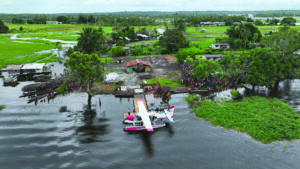
A MAF float plane at Lake Murray. Credit: Terry Harvey
However, the ability to ‘lift up the phone’ and call for help is not a luxury all places share.
Between 2000 and 4000 people on the remote Carteret Islands have lacked telephone or radio communication for decades. The tiny atoll lies 100 kilometres from the coast of Bougainville, reached only by small, open boats.
A MAF team, including IT Manager Karlos Sarunic, installed extensive solar lighting and a long-range radio system in the Islands’ health centre, enabling immediate contact with the outside world.
“Boats go missing all the time,” he says. “If you have an engine that breaks down out there, there is no coastguard. There is no tracking, no phone signal. Nothing.”
“Our staff are the stars of MAF,” says Dom Sant, PNG Country Director. “We’re focused on developing the PNG team, which already consists of 80 per cent nationals.
“Through MAF they get training as pilots, aviation engineers, quality safety inspectors and other skills that will enable them to get a career in industry and train others.”
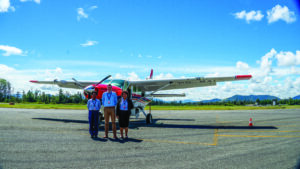
MAF personnel Nancy Ikate, Dom Sant and Lydia Yomba at Mt Hagen with Cessna Caravan. Credit: Aquila Matit
Local MAF pilots include Joseph Tua, who was trained in float plane operations to provide health, education and trade services to remote communities living on the network of Lake Murray waterways in Western Province.
Originally from Ialibu in the Southern Highlands, Captain Tua symbolically combined his pilot’s uniform with traditional face painting at King Charles’ ceremonial dedication of an amphibious Cessna Caravan.
“Flying float planes is a special skill,” says Sant. “Obstacles include driftwood and sandbars. Joseph has also joked about running into crocodiles.”
Whether or not that’s true, Sant agrees that every day with MAF is an adventure.
“We have more than 200 airstrips that rarely look like the 1600-metre sealed runways that I knew in England,” says the former Rolls-Royce aero-engine fitter.
“Our airstrips are often 300-metre grassy slopes and may be frequented by volleyball players, as well as pigs or other animals. MAF pilots will fly over the airfield first as a good warning for people to get out of the way.”
However, pilots occasionally have to abort a landing “because a dog sat in the middle of the runway and refused to move,” he adds.
Sant, his wife, Sequoia, and their three children, Abigail, Emma and Isaac, moved to Mount Hagen in 2022. “By joining MAF, we hope to continue showing Christ’s love to these isolated communities,” he says.
“On Good Friday, a woman named Meri from Wanakipa in Hela Province fell off a rock and broke her arm. The bone was sticking out, and it was two days’ walk over rough terrain for help. We were able to get her to hospital in 35 minutes. That’s what makes it all worthwhile.
“The people who choose to serve MAF certainly don’t do it for the money. We believe there is a God who loves us and we want to serve him – I can see how he is steering me to this role. He is building something beautiful.”
This article was first published in the August-October 2026 issue of Paradise, the in-flight magazine of Air Niugini.