Life support: how a conservation program is helping save tree kangaroos
It’s been 30 years since US biologist Dr Lisa Dabek arrived in PNG. She had a dream to protect the endangered Matschie’s tree kangaroo. Little did she know that this dream would become one of PNG’s most successful conservation stories, as told by Marisa Howden.
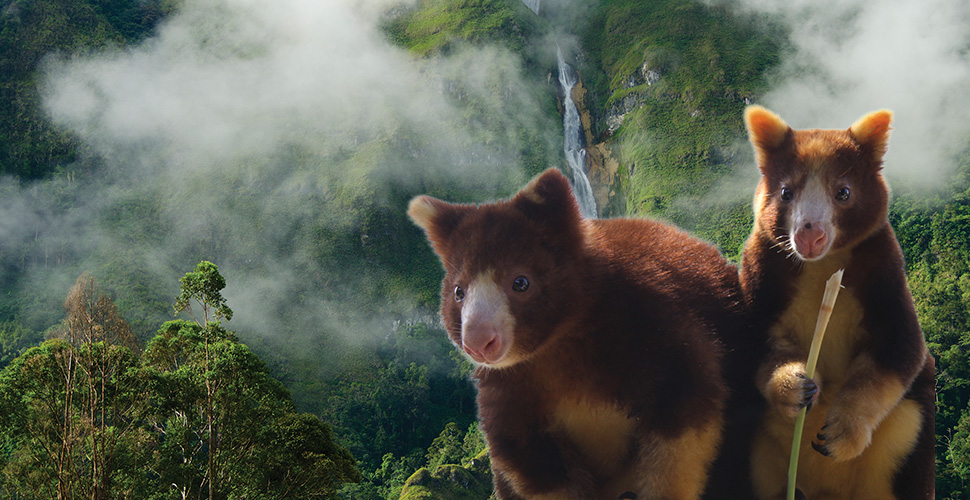
Tree kangaroo habitat in the YUS Conservation Area, and the tree kangaroos that have become Dr Dabek’s passion. Credits: Ryan Hawk, TKCP, BAI.
It’s hard not to fall in love with tree kangaroos, or kapuls as they are known in Tok Pisin. They’re small marsupials with long fluffy tails and cute little faces. Like koalas are to Australia, kapuls have become a national animal of Papua New Guinea, along with the bird of paradise.
“Tree kangaroos are little known animals that are incredibly special. There is so much more to learn about them,” says Dr Lisa Dabek, Woodland Park Zoo senior conservation scientist, founder and director of the Tree Kangaroo Conservation Program (TKCP). “They are the flagship for cloud forest conservation and very important culturally to many communities in PNG.”
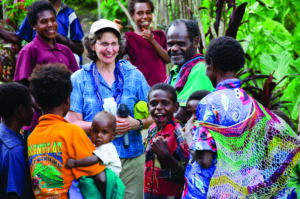
Dr Lisa Dabek, founder and director of the Tree Kangaroo Conservation Program. Credit: TKCP
They are kangaroos in all respects, but have adapted to life in the trees, living only on the island of New Guinea and in Queensland, Australia. When Dr Dabek arrived in PNG in 1996 after she wrote her PhD on the reproductive biology and behaviour of Matschie’s tree kangaroos, it was thought that only 2500 of the species remained in the wild across their range. Today, thanks to the TKCP, it’s believed that healthy populations are thriving in the forests of the YUS Conservation Area in Kabwum, Morobe Province.
Named for the Yopno, Uruwa and Som rivers that run through the area, the YUS Conservation Area protects more than 130,000 hectares of forest and 50 villages against deforestation and overhunting. The area is part of PNG’s Huon Peninsula, stretching from the coral reefs of the Bismarck Sea up to 4000-metre peaks of the Saruwaged Mountain Range between Morobe and Madang provinces.
Establishing the protected area aims to protect the rich biodiversity of PNG’s forests. With vast tracts of pristine forest containing unparalleled biodiversity, PNG is one of three major designated Tropical Wilderness Areas left on Earth. The country is home to about 20,000 plant species, more than 700 bird species and more than 230 mammal species, many of which are only found on the island of New Guinea.
Unlike parts of the world in which deforestation has taken a heavy toll, about 70 per cent of PNG rainforests remain intact. Specifically, PNG’s Huon Peninsula is home to more endemic bird and mammal species (including the Matschie’s tree kangaroo) than any other like-sized area in mainland New Guinea.
“Matschie’s tree kangaroos are an umbrella species, which means that protecting them also safeguards a myriad of other species that share their habitat, including the emperor bird of paradise, eastern long-beaked echidna, dwarf cassowary and New Guinea pademelon,” says Dr Dabek.
The communities of YUS, made up of more than 15,000 indigenous landowners who speak seven languages, have come together to create the first nationally recognised community-managed conservation area in PNG’s history.
Gazetted in 2009, the YUS Conservation Area is a leading example of what community-led conservation can achieve. “When we started, we knew we wanted to work with the YUS communities to conserve the tree kangaroos and also address community needs. What that would look like was a mystery – we just stayed the course and persevered. TKCP grew organically as we reached each milestone for conservation. That TKCP has become a fully locally run NGO in PNG with a great reputation and a model protected area program is a testament to the incredible team members, a majority from YUS, we have had over the years,” says Dr Dabek.
TKCP implements a multi-faceted program that includes community livelihoods, health, research, conservation, education, governance and reforestation.
TKCP supports the government’s ongoing rural health programs through its ‘One Health’ program by adopting a holistic approach that incorporates the health of the people, wildlife and environment. This approach establishes and improves systems for health care, ensures health clinics throughout YUS have proper equipment and aims to give communities access to clean water, balanced nutrition and food security.
Another key program TKCP manages is the export of YUS coffee. “People in YUS rely mostly on subsistence farming and hunting. Coffee offers a rare source of cash income, which families use to pay school fees, cover health costs, improve their homes, establish savings and invest in their businesses. The Tree Kangaroo Conservation Program’s YUS Conservation Coffee program improves local livelihoods while providing incentives for conservation,” says Dr Dabek.
TKCP connects local farmers with international coffee-roasting companies that buy the speciality-grade beans direct at a premium price. To date, the program has generated over PGK1.25 million for coffee-producing families in YUS. Each year, between 20,000 and 30,000 kilograms of coffee are produced by the YUS Conservation Coffee Cooperative.
Today, TKCP is pursuing community-led protection of more forests across the 16,000-square-kilometre Huon Peninsula eco-region, though the NGO has had its fair share of challenges along the way.
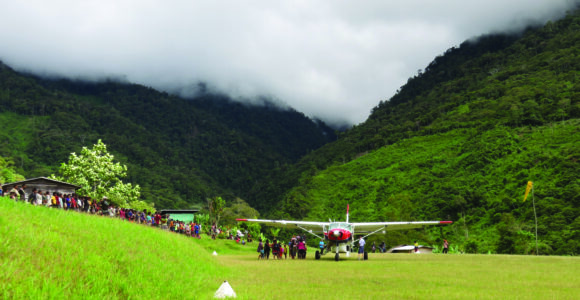
“The remoteness of YUS is both a very positive aspect of protecting the natural environment and the forests and yet access and transportation have continually been a challenge. Getting staff in and out of YUS and transporting the coffee out of YUS is definitely challenging,” she says.
Dr Dabek believes that working in conservation is getting easier globally due to new and advanced technology, but changing political systems that influence funding can be a challenge. “TKCP has been extremely fortunate that we have been able to get solid funding from international governments, foundations, zoos and private donors who have believed in our work.”
TKCP is partially funded through an endowment fund that was set up through the Woodland Park Zoo in Seattle. International grants and donations also help with specific projects like solar lighting and health, but more assistance is needed in funding the NGO’s operational expenses.
“For the first time, TKCP will be partnering with select private businesses who want to mitigate climate change by sponsoring our work,” says Dr Dabek. “We employ nearly 50 nationals in both our head office in Lae and throughout the YUS Conservation Area, and corporate support will help us to offset the costs of running our operations.”
As Dr Dabek reflects on TKCP’s 30 years of conservation, she encourages all Papua New Guineans to take charge to lead their own conservation initiatives to better protect their environment.
“The world can learn that, with support, local indigenous communities can lead conservation efforts and achieve great things. The YUS landowners took a risk and created the very first conservation area in PNG that is now a model for other areas of PNG. Hopefully, this will inspire other groups as well.
“My goal is for everyone in the world to know what a tree kangaroo is and why they need to be conserved. Lemurs, red pandas and other animals have gotten a lot of attention, and the time is right for tree kangaroos,” Dr Dabek says.
This article was first published in the August-October 2026 issue of Paradise, the in-flight magazine of Air Niugini.