The Papua New Guinea government faces challenges in managing its cash flow, according to Yurendra Basnett, PNG Country Economist for the Asian Development Bank (ADB). The ADB’s Outlook 2016 paper on the Asian region says PNG’s debt servicing costs are likely to rise.
Papua New Guinea’s debt levels relative to the size of its economy could actually go down if the government increased spending, according to Satish Chand, Professor of Finance in the School of Business at the University of New South Wales. Mounting an argument that goes against conventional wisdom, he contends that as long as the government investment is well managed and receives a strong return, the long term benefits will outweigh the short term risks.
Papua New Guinea’s agriculture export income in 2015 was less than half 2011 levels, according to data from Bank Papua New Guinea’s latest Quarterly Economic Bulletin. Income from palm oil exports was at its lowest level since 2009, coffee sales were less than half the level of four years ago and income from rubber exports almost halved in a year.
During May, forums were run in Port Moresby, Lae, Mt Hagen and Kokopo to solicit public responses to the Papua New Guinea government’s new land bill. The intent of the new bill is to protect the rights of customary landowners, by extinguishing any State leases, mortgages or sub-leases held by non-citizens. But the consequences for PNG industry and the economy could be dire, some observers are saying.
The minimum wage in PNG will rise to K3.50 an hour from 1 July, from the current rate of K3.36.
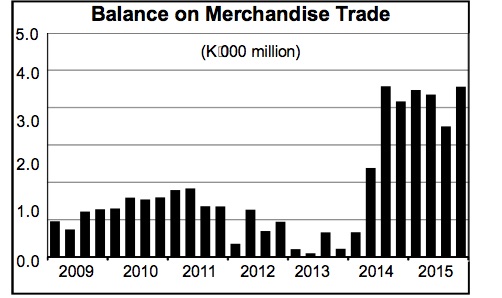
The Bank of Papua New Guinea recently released its December 2015 Quarterly Economic Bulletin, which provides a snapshot of the nation’s economic and financial performance over 2015. Business Advantage PNG provides five key insights.
Moody’s recently downgraded its sovereign rating on Papua New Guinea to B2 from B1. But Christian de Guzman, a Senior Analyst in the Sovereign Risk Group for Moody’s Singapore tells Business Advantage PNG that the agency is ‘quite confident’ about the overall economy’s prospects over the medium-term.
The Governor of the Bank of Papua New Guinea, Loi Bakani, told this week’s Australia–Papua New Guinea Business Forum in Cairns that the bank is ‘determined’ to obtain more foreign currency ‘as soon as possible’ to address the backlog in foreign exchange demand. However, he criticised claims that PNG’s foreign exchange problem could be solved by allowing a free float of the kina, reports David James.
The kina has fallen in value this year, but Papua New Guinea’s dependence on commodity exports means that it can be expected to fall further, says Rohan Fox, Lecturer and Research Fellow at the University of Papua New Guinea’s Division of Economics. He tells Business Advantage PNG that the country faces a difficult task managing the impact of sharp fluctuations in commodity prices.
In an environment of plummeting interest rates, long term infrastructure investment is a sound option for both investors and governments. Financial and business commentator Michael Pascoe, speaking in Port Moresby last week, noted that the difficult global financial environment throws up opportunities for countries like Papua New Guinea.