Papua New Guinea’s economy: an overview
An overview of Papua New Guinea’s economy, including key industry sectors and GDP growth figures.
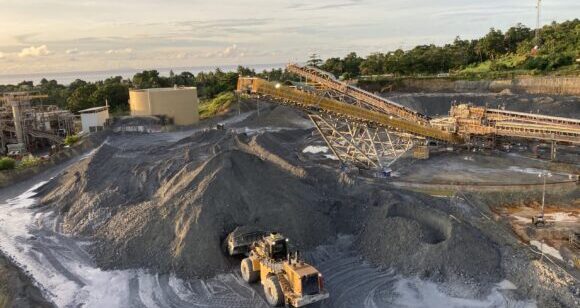
PNG’s economy is dominated by extractive sector projects such as the Lihir mine in New Ireland Province, the country’s largest gold mine. Credit: Newmont
Papua New Guinea is the largest Pacific Island economy. According to the International Monetary Fund (IMF), PNG had a nominal gross domestic product of US$32.71 billion in 2025.
According to the World Bank, PNG is the 14th most resource-dependent economy in the world, with its natural resource rents constituting 27.4 per cent of GDP in 2021.
Since 2010, PNG’s GDP has approximately quadrupled, thanks in large part to the ExxonMobil-led PNG LNG project, which had a four-year construction period from 2010-14. PNG has a significant pipeline of greenfield extractive sector projects that it is hoped will instigate the next economic boom, including the TotalEnergies-led Papua LNG project, which was nearing a final investment decision in early 2026.
The country’s main industries are:
There is activity in such sectors as building and construction, telecommunications, retail/wholesale, tourism and business services. This growth has also been achieved in spite of a gradual decline in foreign aid levels since 1980.
PNG is a dual economy, consisting of modern, capital-intensive and export-oriented industries on the one hand, and a largely traditional, labour intensive and subsistence-based economy on the other.
PNG achieved the world’s ninth-highest current account surplus in the world in 2024, at 15% of GDP, according to World Bank data. This was achieved mostly off the back of the exportation of commodities such as liquefied natural gas (LNG), gold, copper, palm oil, cocoa and coffee.
However, an estimated 85 per cent of the population still live in rural and remote communities and derive a living from the informal sector.
Unlike many other countries classified as ‘developing,’ PNG has never defaulted on an overseas debt, mainly because its debts were at concessional rates and owed to multilateral organisations. In 2018, it completed its first formal international debt raising with the placement of a US$500 million sovereign bond.
In April 2023, The IMF approved a US$918 million financing package to support reforms to address long-standing structural impediments to growth. The program was set to run for 38 months, ending in mid-2026.
The PNG Government has recorded budget deficits since 2013. In 2016, the deficit was K2.11 billion, 3.1 per cent of GDP. In 2026, the PNG government has forecast K29.3 billion in revenue, which would narrow the deficit to K1.6 billion (1.1 per cent of GDP) and keep the government on track towards achieving its long-stated goal of a surplus in 2027.
The 2026 National Budget outlines K30.91 billion in expenditure, 9 per cent more than in the 2025 budget and 59 per cent more than the Marape-Rosso government’s first budget in 2020.
As of 2026, PNG’s sovereign credit ratings are B- from S&P Global and B2 from Moody’s, both with a stable outlook.
PNG’s GDP by industry sector in 2024
- Agriculture, forestry & fishing 18%
- Oil and gas extraction 18%
- Mining and quarrying 10%
- Wholesale and retail trade 9%
- Administrative and support services 7%
- Construction 6%
- Real estate activities 6%
- Public administration & defence 5%
- Education 2%
- Manufacturing 2%
- Transport and storage 2%
- Information and communication technology 2%
- Financial and insurance activities 2%
- Accommodation and food services 2%
- Health and social work activities 2%
- Other 7%
Source: PNG National Budgets